Disclaimer: Transcripts were generated automatically and may contain inaccuracies and errors.
As much as I hate to admit this, I was invited to give a TED talk in 2020 and made the excuse that, oh, I didn’t want to do it because it was like, right after the pandemic had hit and they weren’t going to have a live audience. But in reality, if I’m. If I’m really being authentic and I’m being honest, it was because I was too embarrassed to show up the way that I looked.
Physically, hypnosis helps people take back control of their lives. But here’s the thing. Too many hypnotists struggle to get consistent results with their CLients or grow their hypnosis businesses. I’m Jason Linett, and after more than two decades of building a thriving hypnosis practice, I created this podcast to help you do the same. Whether you’re just starting your hypnosis journey or if you’re ready to scale your business to the next level, you’re exactly where you need to be. Welcome to Work Smart Hypnosis. When you really think about it, major moments of transformation in our lives, these things occur in a split second. Yes, okay, it might have been something that was building up over time. It might have been an issue that persisted, then compounded, then hit some sort of a moment of threshold where enough was enough, and then everything changed.
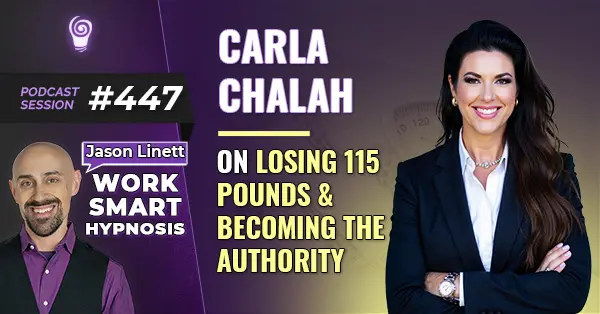
However, when you really look closely, you can pinpoint the exact moment where something shifted, and you can’t go back to the old way of living. Hey there, it’s Jason. And welcome back to the podcast. This is session number 447 with Karla Chawla telling her story about losing 115 pounds of body fat, building strength, becoming the authority, and really just amplifying the success of her business. Now, there’s one part of the conversation that I really want you to hear, though. It’s the aspect as to how we had met at one point before, and then a little while ago, we reconnected. And as I say in this conversation, the person who was then in front of me was not the person who I originally met.
We’re gonna go through her story in terms of her unconventional path from being the client of therapy to then becoming the hypnosis practitioner, and why there were some disillusionments and why there were some hiccups in that journey, kind of looking at her life path through the filters of more conventional methods, and then specifically what happened differently as a result of then hypnosis becoming a part of that story. And also as you hear the insights as to her journey from South Africa to Now here in America. And just little insights as to how. Well, just simply put, she is truly a worker in our industry. Someone who is, yes, out there teaching, but also at the same time truly running her business, actually seeing clients and someone to really listen to in terms of what actually is working right now.
There’s quite a number of references we make throughout this conversation, so be sure to head over to worksmarthypnosis.com 447. Really, for every episode of this program, you can do that. We set up a little fancy redirect so that way it’s easy to then access the show notes and all the resources we reference as part of this conversation. One part that I really want you to listen to carefully, though, is when we hit onto the topic of authenticity and vulnerability, not just with our clients, but also with ourselves. This is something that, oh, this story from around 2016, or maybe even 2017, I forget which one, but I was at an event and somebody was speaking in terms of business, especially for hypnotists. And the conversation was then introduced that the clients don’t care about you, they only care about their result.
Well, let me be careful as I say this next thing out loud, and maybe it’s a little safer because I’m doing this right now more as a monologue to the intro to this podcast conversation you’re about to listen to take a moment and think about what are the things you know about me? And, oh, let’s go there, because it’s more of a monologue here and you can’t respond back immediately. What are the things that you enjoy about what I do? And let me say this. What are the things that sometimes you go, oh, that again, there’s gotta be something. I know, it’s okay.
And I mentioned that, though, because, well, here you are still listening, here you are still engaging and realize that the people who we follow, whether it’s actors, performers, musicians, politicians, or even people within our industry, it’s not just because they teach this one thing. It’s also the story of who they are. And there is an art, there’s a science towards how do we bring in the right aspects of ourselves and our stories. And that’s the thing I get into more over on the attract preschool clients side of my world. But it’s where people do business with people. And I love this conversation you’re about to hear because it really is the opportunity to meet someone who is truly doing the work represents the transformational journey that our clients want to achieve.
And Then is beautifully helping people to then do the same thing in their own lives. How cool is that? So check out the details [email protected] 447 and hey, let’s dive in. This is session number 447. Carla Challa on losing 115 pounds and becoming the authority.
So I came into hypnosis in kind of a roundabout way, as I assume many hypnotists do. I had always had a fascination with the mind, but later in my teenage years I had a pretty dramatic traumatic event happen to me and spent the next several years in and out of therapists offices to the point that my parents got very frustrated with me because I literally wrote a novel and every time I would switch therapists or I got fired by a therapist, I would hand them my novel and basically say, read this and then we can talk. Which needless to say, didn’t go over all that well in many instances, but.
Became a great strategy for client screening later on in your career. But we’ll get to that eventually.
And in any case. So the next logical step for me was to pursue clinical psychology. So my undergrad is a triple major in English, psychology and sociology. And I then decided to actually, it was actually at that point, I’m originally from South Africa. I did my undergrad in South Africa and decided to come to the US to do grad school. And I came to grad school, studied clinical psychology and in my final semester really started to feel very disillusioned about the fact that was working with a doctoral student and were working with kids aged 5 to 9 and a lot of the approaches to me felt like band aid approaches. It really wasn’t addressing the issue.
I didn’t feel like were really doing these kids a service and started looking into alternatives, other approaches to really generating, for lack of a better word, healing, mostly my own, but also with the curiosity of helping others. But initially really it was to help myself. And for whatever strange reason I kept coming across hypnosis. But being somewhat scientifically minded myself, I was a major skeptic and came across a course and I was living in Massachusetts at the time and working and came across this class, like quite a lengthy, extensive class out in California and decided, you know what, I was going to take a sabbatical from my grad school studies and flew out to California.
And I can honestly say a long story short, within the first two weeks of my training, I personally experienced more transformation than I had probably in six or seven years of talk Therapy, which was enough to obviously convince me. And the really funny part of the story is that I was very close to my grandmother and after I had completed my foundational course, I shared with her and had been sharing with her all along that I was doing this. And come to find out, I don’t know how nobody ever told me this before, but my grandfather actually was a dentist and had used hypnosis as part of his dentistry practice.
Nice.
So clearly it was somehow in the blood and I just had no idea about it. So that’s kind of a. A funny sort of adjunct story to long winded response to what got me into the hypnosis.
So then from the experience of going through formal education, and I have to throw in a statement of, oh, that makes sense. When you say triple major, though, here you are in the, like two weeks of the hypnosis training. Like, what would you say was the thing that stood out as being different for you?
In terms of hypnosis, you mean?
Yeah, that helped in terms of achieving not only what you were looking to learn, but also breaking through some things of your own.
I really think that the thing that stood out the most was how efficient it was as somebody who you and I are more or less the same age, so you’ll be able to relate to this. But I was always, even though I was a really good student, I was always the person looking for the shortcut. So I was the first one to go and buy the Cliff Notes or to. I’m like, well, why would I like once. Google came out way later on. But I remembered in my final year of my undergrad, I downloaded a summary of one of the books that we. I should probably shouldn’t be saying this publicly, but never actually read the book and downloaded the summary. And I remember the professor commenting on my paper. I literally went and bought the book. It was an open book final exam.
And highlighted a few things from the summary and scored really well on the exam. And she was like, you have such a solid understanding of the text. But, you know, my point is that one of the things that I love most about hypnosis is just how efficient it is. It’s, all of us have a finite amount of time and how we spend that time is so important. And personally, my preference is not to spend my time every week telling the same stories in a therapy office. Nothing against therapy. There’s a time and a place for that, for sure. But in terms of my own personal true transformation and healing, it just stood out to me how incredibly efficient and effective it was in such a short period of time.
You’ll hear some of the intentional talking around that I’m about to do here, which is. No. Here was a person who attended a training of mine one time, and she was a licensed mental health counselor. And the way that she put it was that it finally gave me the ability to sit down and just ask, what do you want to work on right now? What’s the change you want to be noticing this week and not get caught up in old story, not get caught up in potential diagnosis, just that streamlined effect of things and how really there’s not that many. I’d be curious to hear your take on this. There’s not that many techniques that, quote, began in the hypnosis industry. We are modeling methods from other industries, yet doing them with hypnosis. And that’s part of what that streamlining comes from.
Absolutely. Absolutely. It really is this culmination of an assimilation of things that just really make it an art. I feel like there isn’t enough talk about how much of an art the skill of hypnosis is. It’s not something that you can read in a book or take a simple training and be masterful at it. And it’s something that, with a lot of my certification students, you know, I say to them, and ironically, it’s actually what kept me back from training for so long was this idea of, well, how do I download what I know to my students until finally I could personally overcome that and realize that’s just not realistic, it’s not practical. Teaching people and modeling and demoing is really the best way for somebody to learn the skills and then to refine those skills and to individualize them.
Because every single one of the hypnotists that I know have their own way of doing things. They might be doing, quote, unquote, the same technique, but they have their own. If they’re worth their salt, they’re going to have their own spin on it in some way. I actually remember the last training that I did. I was showing my students your Elman induction that you did on YouTube. And you know how helpful that was to give them a different way of looking at things. Because obviously your way of doing things is different than my way, is different than somebody else’s way. And getting back to what you were saying about diagnoses, I think that’s an unfortunate thing in the mental health field at large.
It was one of the things that I found incredibly frustrating was seeing the number of kids as part of that doctoral program that I was doing aged five to nine that already had diagnoses and probably will carry those diagnoses for the rest of their lives. And I think it’s a major shortcoming in terms of the mental health field and helping people live outside of their diagnosis as opposed to really embodying whatever their diagnosis is.
Yeah. Which I just took note of that. I want to come back to that. But in terms of something you just said about confidence to teach, aside from, let me show you this video of this guy named Jason and show you how not to do the element induction, we’ll set that aside, too. That was not a no. That was only laughter, but that was not a no. There’s a couple of turning points in your story here, which would be that there had to have been a similar internal dialogue to, let’s say, let’s put it into the category of confidence to have the confidence to then, quote, open up shop and begin working with clients yourself.
It’s ironic because I think back of how naive I was, which I think sort of ignorance is bliss.
It really is. Yes.
It was before the Internet. Before. Well, God, I’m, like, really aging myself. But I didn’t have a website. I didn’t have any of those things early on in my practice. And I came back from my training and was like, okay, well, I’m going to practice out of the basement of my townhouse in Watertown, Massachusetts, and got all excited and picked out the paint color and found a chair and changed the light fixture. And then I was like, oh, okay, now what? And then started networking. And it was around that time that the Internet started to become a thing. So I built, like, a really basic website. Know that this is something that a lot of my students and a lot of this idea of having the confidence to start.
For me, it wasn’t necessarily the confidence to start because I think I was Eve, as I said, but it was more this black and white thinking, because I think that’s typically a little bit of a. I don’t wanna say a weakness of mine, but definitely something that I’m always working on is needing to do things, quote, unquote, perfectly. So I put a lot of pressure on myself when I was first starting my practice. I remember, like, starting sitting with the big red. What is it? Like the hand suggestions?
Hammond’s collected metaphor.
Yeah. And I would research and I would sit and I would have sort of a conversation with clients before they would come in. And, you know, I would have all these ideas of things that I was going to say, and I was going to do. And I, like, mentally had to rehearse and prepare myself. And that probably lasted, like, if I’m really being honest, that lasted for the first few years of my practice, which is sad when I look back at that, until I finally, I think confidence is the right word. Develop the confidence that, like, everything that I need, I already have.
Though at the same time, this is not meant to be embedding hypnotic language patterns, though it is the more you prepared, the less you ended up eventually needing that preparation.
Yeah, yeah, absolutely.
So then you mentioned sort of the hesitation to eventually begin teaching. Like, what would you say was that sort of confidence shift that then empowered that?
That’s a good question, actually. I mean, I had a little bit of help because there was somebody who initially asked me to teach with them. It felt a little bit easier doing it with somebody else where it wasn’t all on me. So from that perspective, I think that was helpful to me. And then as with many things, like, once you realize, like, you can do it, you’re actually really good at it, then the rest is history. It becomes easy after that, I think, as with many things, it’s like once you actually get started and you actually start take action, the rest falls away. It’s no longer an issue.
Yeah, yeah. Which I know that one of the bigger points of this conversation was going to be around this theme of turning points that, you know, I got to, I think, was that the first time we’ve actually met in person?
When?
Like a month ago or had we met in person before?
I think we’ve met in person before, but we’ve never really spent time together.
Or that this was at ICBCH conference. And simply put, the person who I ran into was not the same person who I met before.
No.
And I’ll let you take the stage of telling that story.
So I’ve had a pretty dramatic personal transformation over the past, I would say, year and a half. It started in June, actually. Technically, June 1 is a starting point that I like to point to of 2023. I’m a mom of two kids. I. In my teenage years, and Even in my 20s, I was very active. I was a competitive tennis player, a competitive swimmer. I used to run half marathons. And then fast forward had my kids back to back in 2015 and 2016. And we know what happened in 2020 with the pandemic. Not to make exceptions, excuses, but I gained a significant amount of weight. Like, we’re talking over a hundred pounds of weight, to the point that I felt completely Trapped. I felt like I didn’t recognize.
I saw myself one way, and then I would see a picture of myself and I’d be like, oh, my gosh, who is that? Like, I didn’t recognize myself. And looking back, it was sad because I think my kids missed out on whole time period where I was essentially in hiding. I did not show up on camera. There’s no full. Barely any full body pictures of me. I’m always the person hiding in the back. And as much as I hate to admit this, I was invited to give a ted talk in 2020 and made the excuse that, oh, I didn’t want to do it because it was like, right after the pandemic had hit and they weren’t going to have a live audience.
But in reality, if I’m really being authentic and I’m being honest, it was because I was too embarrassed to show up the way that I looked physically. And a few more years went by, and then early 2023, and I can’t believe I’m actually going to say this publicly, but I one day stepped onto the scale and had hit 300.5 pounds. And I don’t know what it was about. I mean, there were a few things that kind of happened leading up to that, one of which was having a conversation with a colleague. And I remember sitting in my office talking to her and saying to her, I don’t know what the heck my problem is. I’m so good at helping others to lose weight, but I just can’t seem to help myself.
And as I said, dawned on me, I was like, oh, my gosh, Carla Will, no wonder you can’t lose weight, because this is a recording that’s playing in the back of your mind constantly that it’s like all these, like, false starts and fad diets and all these different things that. I mean, I had gotten so desperate that I even started to look into the beginning of, like, when ozempic and all of these things started coming out. And again, it’s not one simple thing. But When I hit 300 pounds, I was like, you know what? Enough is enough. Like, I’m done with this. Like, I. It’s time to really reclaim myself. And I think it’s inauthentic when hypnotists say things like, oh, hypnosis makes weight loss easy. That’s total bs. That’s not real. That’s not true. However, it does make it easier.
And it’s like the story of Dorothy and the Red Shoes. It’s like I had the tools I had the resources probably better than most all along. And one day at a time, one foot in front of the other, I really started honing in on first and foremost before I even started thinking about eating habits, really working on my self talk and my mindset and specifically the way that I spoke to myself first thing in the morning when I was getting ready for work. Because I noticed, and as we all know as hypnotists, were most suggestible kind of in those morning hours, the things that I was saying to myself in the mirror, I would never say to another human being. Like I would be mortified saying some of the things that I was saying to myself to another person.
And as that started to change, little by little, it was this ripple effect of my eating habits started to change. I started feeling more motivated to start moving my body. I started to make it a game. I bought myself a Fitbit.
Nice. Yeah.
Later in, which is funny to point to a Fitbit, but I got my kids both Fitbits too. And it started to become this game, this competition. Unfortunately for me, I didn’t really think of the repercussions of that because apparently my kids also inherited my competitiveness. So we’d be on vacation and we’re waiting on a cab and my daughter is running up and down the stairs to get more steps than me, which did not bode well for my competitor.
I think that fits into the category of sometimes the good problems in life are the ones you invented yourself.
Precisely. And it’s funny. I, long story short, I, as of today, am 115 pounds down. Nice. 100% naturally. Really, first and foremost, changing my mindset, obviously changing my eating habits. I did work with a nutritional coach, which was really helpful and really upped my protein and started to. I hate the whole like mindful eating thing, but there definitely was a component of really starting to recognize what my body responds best to. And then more recently, as of the past few months, really integrating exercise as well and learning to exist in the gray area a little bit too, which has been a big thing for me.
What do you mean by that?
I really mean breaking out of this black and white thinking model of where it’s all or nothing. I laughed. I had a trainer approach me at the gym recently and say to me that I’m going to hurt myself because I’m lifting too heavy and that I’m the strongest woman in the gym, which in the past I would have taken as an insult, but I chose to take as a compliment. It really got me thinking and it’s funny. I saw a quote this morning, there’s one degree of difference between water and ice. And that really struck me when I read that, because I think sometimes it really is about recognizing that we don’t have to be in one camp or the other.
I’ve been a bit sick with the flu over the past week and a half and found myself eating certain things that I don’t typically eat. The good news is that I wasn’t beating myself up the way that I would have in the past, but really working on this idea of it’s okay if most of the time we’re doing the right things and we’re doing the good things, and there shouldn’t be this expectation of perfection. Because I think that’s often what keeps us stuck more than anything.
I mean, those are themes that often, as we get into the work with clients and I flashback to how part of my weight loss journey was also getting into heavy weightlifting and having that quick, rapid, emotional turning point. I was carrying my, at the time, newborn son up the stairs. He’s now about to turn 12. Wow, this story’s old. And I’m carrying him up the stairs and I’m having to sit down because I’m out of breath. And we can look to those specific moments where you can’t go back to the old way, whether it’s stepping on the scale and seeing the number that you really didn’t want to see, or halfway up the landing in a townhome where the stairs turn halfway through and having to pause there out of breath.
And I’d say in that moment, emotionally, I lost that last 40 or 50 pounds. Yet that’s the place where something shifted and I was now working on the solution rather than working on the problem of that. And there’s an aspect of this that I might be asking this for my own personal curiosity, which is a lot of the social media that you’re now putting out around yourself and, you know, your business, it’s bringing people into that journey that you’ve been on. And it’s this beautiful example of how sometimes the most effective thing that we can do in terms of online content is that of documenting and capturing rather than the mindset of creating.
And it’s that here’s this journey that you are on, and I’m curious if you’ve seen any results in terms of how that’s brought in a different clientele than what you were seeing before.
Yeah, that’s an interesting question. I would say the response is twofold. It’s been interesting to See how, for lack of a better word, triggering it’s been for certain people, to the point that I’ve received some interesting hate mail.
Congrats.
Which lets me know that I’ve made it, apparently, where people don’t really like you pointing out their shadows or their wounds. Literally having people tell me that I’m like, disempowering women and that it’s a disempowering message and that kind of thing, which my response typically doesn’t sound like a me problem, but I think on the flip side of that, and overwhelmingly so, thankfully, is the positive feedback that I’ve gotten from people. Because I think so often for people that are in the quote, unquote, change work field, when we are on social media and we are sharing our own personal stories and our own personal vulnerabilities, it is a very vulnerable space to be in, because there isn’t that instant gratification that we would have sitting in the office with a client where we’re sharing a story or we’re demonstrating something with a metaphor.
Sometimes it feels like I’m just putting stuff out there and shouting out into the void, and I’m left to my own devices of making sense of that or filling in the blanks, so to speak. But I do think that there’s something really beautiful about being willing to be vulnerable and striking that balance of telling our stories, but with the intention of facilitating inspiration and change in others. Because I think that once people are inspired or they’re ready or motivated to change, I think seeing somebody else on that same journey or hearing the vulnerability from somebody who has been through some of the similar things that you’ve been through, I think is really powerful and really empowering.
I mean, it’s that like attracts like. And clearly the most appropriate thing we should do right now is briefly sidebar and talk about politics, because that’s gonna bring everybody together. Okay, I’ll make it as brief as I can. It would have been. I forget what year this would have been, but it was the time that Donald Trump tweeted something in the middle of the night, and it was the random collection of letters that spelled out covfefe, C, O, V, F, E, F, E. And it was that weekend that I was doing stage hypnosis shows at a school. And the classic routine, person. I’m tapping on the shoulder now, in a moment, when you open your eyes, your name is and has forever been Kofefei. You’re gonna be so proud of your name, and you’re gonna tell Us all about where the name came from.
And, I mean, this kid at like 16 or 17 years old was just flawless of. Well, it’s a family name. Oh, yes. Well, it was my great grandfather’s. And, well, part of it originally was French, but then we moved over to Denmark, so part of it’s Dutch. And just. He was spot on. And at the end of it, I did have a parent come up to me. I think it’s really offensive that you made fun of the president. And I went, hey, I’m gonna. Let’s pause this conversation. Give me your email address. I’ll pull the video clip. I’ll send it to you. And I sent it over just with one commentary of. I never said the name. I never applied any judgment. I just took a word that was trending in pop culture that week and made a bit of it.
And I never said this idiot or this genius said this. And it was just that quick moment of.
Did you say, thanks for proving my point?
Well, I just had the quick moment of now, the intentional hypnotic language. Isn’t it interesting that you heard something this offensive from someone who never once mentioned a name or cast any judgment?
Yeah.
Hope you have a great day. And I got this wonderfully thought out message going. Thank you for that. I’ve been dealing with a lot of things in my personal life. I was probably responding from a place of anger to something that wasn’t even your fault. I looked you up online. Is this something you could work on? I went, absolutely. I think you should work with someone else, though. And it’s that, well, I mean, I got told to go f myself this morning because I’m moving this weekend. And the person who did not tell me, hey, I’m on the way to come pick up that thing that you’re selling, and suddenly was at my front door as I was leaving for the dentist. It’s that awareness that sometimes when we are the target of something, we may not necessarily be the target, though.
This kind of brings us to the topic of working with clients with things that are still something you’re dealing with yourself. Working with clients on things that not necessarily it worked or didn’t work with you on, but something that you’re still in process on. Were you working with weight loss clients as you were going through this journey, or is that something you set off to the side?
I was. And there’s something really beautiful about that as well, and seeing the humanity in ourselves and again, being willing to be vulnerable with clients. Clients and using that journey as this intricate dance and this artistic creation, not only in one’s own personal life as the practitioner, but everything that you’re learning and that you’re becoming aware of for the benefit of the client.
Yeah.
And I think having done this work, I think it’s going on almost 16 years at this point. One of the things which really stands out to me is this idea of healing the healer. And again, for lack of a better term, but really being authentic with oneself and recognizing that we’re all human and it doesn’t exclude us from working on something if it’s something that we’re still personally working on. And I’m purposefully using the phrasing working on, because I think the problem comes in when practitioners are inauthentic, when they’re aware of something that’s problematic, but there’s no intention to fix it.
So, so often, and you and I have spoken about this before, this idea of going to hypnosis conference and you see fat smoking hypnotists standing outside and not to be judgmental, but I think there’s so many of them that have no intention of working on the very thing that they’re working with clients. And to me, that is incongruent. I can’t imagine working on something like, let’s say I’m like a nail biter. I’m somebody who bites off my nails. Thankfully, that’s not an issue that I have. But then taking clients into my practice and working on nail biting, I don’t think that’s something that we should be doing as practitioners.
Well, it’s that it represents something that we’re in the middle of teaching a training right now, that the phrase was like, here comes this opportunity. And even those little stories that you’ve got. It was Richard Nongaard who had this great thing about there’s some hypnotist who train and would almost boast that they’re a hard person to hypnotize or they’re not easy to be hypnotized. It’s like, well, great. There’s your fastest way to have a bunch of complicated client sessions. And it’s to find those places that here’s this opportunity and here’s this chance to tell the story in terms of what it’s helped you to do, even if it’s something seemingly small and insignificant. Though it’s where my weight loss journey actually began, with getting a salmonella. And like, three weeks later, 15 pounds down, I looked fantastic. Would not recommend. Although, again, it’s that.
And here’s the sort of theoretical Question coming into this chat then, which is that, what do we do when we don’t have that, let’s say, organic turning point? You on the scale, me with my son on the stairs. What is it that we do to facilitate that turning point where now all that knowledge that clearly we already had then take shape and then become something we can then more easily act upon?
I think you basically answered that earlier by saying really finding what that emotional turning point would be for that client. Right. And part of that, in my opinion, is practicing personal growth and having a growth mindset. Because if we can understand ourselves better and we can understand how our own minds work better, I think it gives us a unique perspective to be able to in parallel create and collaborate with clients. I think the worst hypnotists are people that are unselfaware. I mean, again, nothing against therapists or psychiatrists, but some of my worst students have been people that have been in the mental health field because they’re so insular in terms of looking for a diagnosis, that they’re not coloring outside of the lines or thinking outside of the box.
And again, I think that’s where the art of hypnosis really comes in, is this idea of being self aware and having this sort of back and forth dynamic and collaboration with the client where it’s not that we’re making it about us, but we’re drawing from our own resources in order to understand the client better. Sort of the, this mirroring effect of what is it that’s keeping this person stuck and how are we going to facilitate whatever that opening of the window or kind of letting in the light or that emotional turning point that you referenced before of whether it’s through imagery or whether it’s through actual experiences that the person has had or helping them connect the dots. I think there’s something really powerful about that. It actually just made me think of a, a fear of flying client that I had.
And she was a funny story because like type A analytical thinker works for Raytheon and she had been doing online dating and of course, as Murphy would have it, she met this amazing pilot, this significant fear of flying to the point that she literally was like xanaxing herself out of her mind. Like she would basically barely be functional. She would fly here and there for work. But she told me that she was like way over whatever the dosage should be. Yeah, you know, I think it was in our first session that we had together. She was like, one of the things that really freaks me out is when I’m sitting on the plane, and I see them, like, de icing the plane and makes me not feel safe.
And obviously, I’m really paraphrasing this, but my response to her was, I said, so we live in New England. This morning when you drove over here, did you not have to scrape your windshield in order to be able to drive your car? It was funny because it was obvious to me in that moment something that simple in terms of creating a comparison or a metaphor. She was like, huh, I had never thought about that before. I said, yeah, so this is just something that they do. And I said, and that being said, have you ever hydroplaned when you were driving your car? And of course, like, your heart might skip a beat for a second, or you might notice that uneasy feeling of your car feeling slightly out of control for a moment, and then you come back to the road?
I said, that’s like turbulence when you’re on a plane, except it’s a lot safer, There’s a lot more car accidents. But, you know, it’s those kinds of moments where we can take opportunities and kind of help clients to connect the dots and for ourselves, quite honestly. And it again, is from this place of self awareness. Like I often use the metaphor or the analogy of those dots on a page that you’re connecting the dots by numbers and at first you can’t really see what the picture is. But as you start to connect the dots, you start to have an understanding of what the picture is even before the picture is complete.
And then there’s this aesthetic appeal of once all the dots are connected, you can actually see what the picture is, and you can enjoy the picture, and then you can color it in or do whatever it is that you want to do with it. And that’s like a hypnosis session. It’s helping clients figure out where they’re going to start in terms of those dots. Ultimately, what the picture is that we’re creating and helping them to connect those dots.
Well, it’s that there’s more than one specific way to get there correct. And sometimes when we’re not sorting for everything else or trying to run XYZ protocol, that’s exactly these 12 steps. And if you don’t do them in the right steps, they’re not gonna work and it’s not gonna be effective. Instead, though, to listen for that one place where here was that she gave you the roadmap. This is the place that I start to have that fear. And if that story in her mind can now take on a different ending, that’s what becomes that domino effect similar to again, the paint by numbers moment, the filling in the dots. We’re just combining all sorts of metaphors right now. And, and I’m pretty sure at least we’re on track with what we’re talking about. That.
No, it’s that suddenly here is that correlation of now that this one thing doesn’t work the same way, the rest of the system begins to fall apart. I mean, I’ve got the story of somebody who had. This is when I was in Northern Virginia and someone reached out who was local and he’s working with someone that the phrase was, oh, she’s got a sugar addiction. And no matter what I’m doing in the session, we’re not progressing well. What are you doing? Well, we’re three sessions in and we’re stuck on this one event when she was 17 years old. There was nothing violent, there was nothing sexual, that there was this offensive moment with her father and she’s not about to give him any sort of forgiveness for that.
And I’m listening and going, her father could have been this horrible person and this could have been this hideous event. Though it doesn’t necessarily have to be the reason why she eats one way or doesn’t eat the way other way. It’s like, have you tried just talking to her about the sugar thing and the end of the story, which I’ve hinted at this before, but here’s the detail where he goes, all I did was ask her how would she rather feel when she is drawn to that food. And she said it herself, she goes, I want to notice that food as the over processed garbage that it is and just eat normal natural foods in the way that I can find them, I can look at them and I know exactly what they are.
He goes, and then I hypnotized her and I said that stuff back to her and the issue was gone.
Yeah, And I think that’s so beautifully put because it’s something that I emphasize, and I’m sure you do too, to your students, where sometimes I think a lot of hypnotists think they know better than the client and they’re almost like looking for the problem as opposed to just navigating them towards whatever the solution is that they want. It’s almost like trying to take on too much of therapeutic modeled approach of, oh, well, if we can find the root cause, then, you know, we can fix this. And I think for me personally that was one of the most frustrating parts about going through talk therapy was the sort of overemphasis of. I knew what the traumatic event was. I knew how it affected me. I didn’t need to be talking about it.
I didn’t need to have somebody rehearsing it with me over and over again. All I wanted was to feel better. And now looking back, it’s not that it never happened. It’s not that I don’t have a memory of it, but it’s almost like a movie that I once watched that I have no interest in watching anymore or really recalling. And I think that’s where sort of the squashing of whatever that emotion is that was attached to whatever the event was or how the person was making sense of it in their own mind. I think that really speaks to the power of hypnosis is being able to detach those emotional connections or attachments that we have to the stories that we run in our minds.
So I’m hearing something revolutionary here. Are you suggesting that we start the hypnosis process by focusing on helping the client get what they want?
Imagine that.
Wow.
That’s right.
We’ll test it out and see how it goes. Quick question here, which would be that. And you might have already answered this and go. The thing I already said. Yeah, that it would be that. How has your own journey, let’s say, shifted how you work with your own clients?
I don’t feel like it’s shifted that much, to be honest with you, because I feel like there’s always something that we’re working on. I definitely see myself as somebody who has always been quite self aware and. And whatever it is that I’m working on creates a conduit to be able to use some of those resources with clients because we don’t know what we don’t know. So I. Obviously there are certain things that have shifted. I think now that I feel like I’m a little bit more on the other side. I feel more comfortable being even more vulnerable than what I was before. Before in terms of my own personal experience working with clients. Like, I feel like less of an imposter, which. That’s very helpful when you’re working with a client for sure. So there’s definitely a different level of confidence. And it’s.
I think confidence is so key in doing this work because if we can see our clients on the other side or quote, unquote, healed from whatever it is that they’re coming in for, I think there’s something really powerful about that, especially when we’ve personally experienced it and we know that it’s possible.
Where can People find more from you. How can they connect with you?
So people can connect with me through my website. It is hemispherehypnotherapy.com like the Northern and Southern Hemisphere or the two hemispheres of the brain. I also do have social media channels. I have TikTok, Instagram, Facebook, YouTube. You can just search hemisphere hypnotherapy. I’m always happy to answer any questions that people have. If you are on a weight loss journey, I would love to chat and see if there’s any way that I could help. And I really appreciate you taking the time to chat to me today, Jason.
Absolutely. Any final thoughts for the listeners out there?
I would say I want to end with a quote. It’s one of my favorite quotes of all time. It’s something that I really love my life according to and it’s anay nin quote. And it goes, life shrinks or expands in proportion to one’s courage. And I think with so many things, if not all things in life, once we have the courage to put one foot in front of the other and to really create change for ourselves or to create change for others, the rest essentially follows. Things really start to exponentially just open up for us. And I think there’s something really powerful about that, just having that courage to do the thing, whatever the thing is.
Hey there, it’s Jason. And in this wrap up segment of the podcast, I want to go back and kind of amplify something that was part of the conversation that you just listened to with Carla that specifically. Well, two parts. One would be the modeling and then the individualization of the methods that we do as practitioners, but then also the documenting of her journey. Go take a look at any of the social media platforms that she’s active on and you’ll see exactly what I’m talking about. First of all, as hypnotists, we are often in this world where there’s a catchphrase that I’ve developed the little hashtag of we help people. And that really was developed at one point as an inside joke. I think it might have been with Chris Thompson and Mike Mandel.
And it came around to how, why was there so much infighting and us versus them and even politics of this technique versus that technique. Schools of thought that I’ll put it out there, have kind of lost their popularity from the narrative of, oh, if you don’t use this technique, you’re not going to get results. Yeah, there’s still some of that out there. However, it’s not as prevalent as it was before, when the reality is it’s the word that Carla brought up in the conversation around artistry, which is that it’s the way that we make it our own, but then again the way that we then make it the clients based upon what they bring to the client session. I’ll do an episode on this in a little while. But how the intake process you do with your clients really comes down to four questions.
And yes, I ask more questions than this. What are you doing now? What would you rather be doing? And how are you feeling now? And how would you rather be feeling? Once we have those four criteria, we can apply that to nearly every technique we possibly would have at our fingertips. And by doing so now, every method becomes a universal approach to change. If you want to see more on that, go over, check out hypnoticworkers.com or Worksmart Hypnosis Live. One is self guided, one is the same thing, plus real time interaction.
The other thing I wanted to amplify here was just this aspect of documenting her journey online, which was that she was putting up videos, sharing her insight as to, you know, this exercise session that she did or something that happened along her own personal journey, which just to throw in a nuance on that one here it’s that as business owners, as people, we get to choose how much of our own stories we bring. And it’s a bit of an art and a science as to where we shine the spotlight in our stories. We don’t have to reveal every personal detail about ourselves yet we can shine the spotlight on the parts that are gonna beneficial to the audience. And I may be blanking here, but let me just say it anyway.
Sometimes there is the value of creating a piece of content without a direct goal of a monetary outcome or business outcome attached to it. And I’ll give you an easy example of this. You’re listening to it right now. The first 20 or so episodes of this podcast, really, I’d say even the first 40 or 50, you know, go back and find those older episodes. I was still finding my voice, I was still finding what this program was eventually going to be. And I’m actually looking at my computer right now, the folder where all the audio files are saved. And for these episodes that have started to come out in 2026, it’s a little folder that’s marked WSH Work Smart Hypnosis 3.0. Because in my mind, this is the third evolution of this program.
So that’s often one of those reasons I see people sort of start and stop the game of becoming the face of their business and publishing valuable content online. It’s because they’re too tied to the immediate outcome of it. When instead over time, you’re going to find your voice, you’re going to find your audience, that audience is going to find you. And that’s where you build something incredible. Thank you for listening to the Work Smart Hypnosis podcast with Jason Linett. The more we’re all successful, the more we’re all successful. I’ve made that statement for years. It’s why I do this show. And here is one thing that you can do today to help do your part. Go to worksmarthypnosis.com podcast. Go there and make sure you’re subscribed on your favorite podcast platform.
And if you’ve enjoyed this episode, I’d love it if you’d leave a review. Your feedback helps other hypnosis professionals find the show. Subscribe and share your thoughts today @worksmarthypnosis.com podcast.