Most people starting a hypnosis practice assume that the broader their appeal, the more clients they’ll attract. So they position themselves as a hypnotist who can help with “stress, habits, confidence, sleep, and more.” Then they wait for inquiries to come in.
But one of the first lessons in learning how to become a hypnotist with a sustainable practice is that narrowing your focus actually expands your reach. Who you serve matters just as much as how well you serve them. That’s where choosing a niche comes in.
A Hypnotist for Everyone Is Memorable to No One
When a potential client searches for help with a specific personal challenge, they’re not looking for a generalist. They’re looking for someone who speaks their language, understands their situation, and seems like they’ve navigated this exact problem before.
A practice that covers everything can technically help them. But nothing in the messaging signals that. The client sees a vague list of services and scrolls past to find the practitioner whose whole brand seems built around their particular need.
This is the core tension new practitioners face. Listing every possible application of hypnosis feels like thorough marketing. In practice, it makes you invisible to the people most likely to commit to the work.
The goal of niche marketing is credibility and visibility, not limitation. Clients who find you through a specific specialty tend to be more motivated, easier to work with, and far more likely to refer others facing the same challenge.
The Strongest Niches Combine an Audience and an Outcome
A hypnosis niche can take several forms. Some practitioners organize around a focused personal challenge: smoking cessation, sleep improvement, weight management, or performance anxiety. Others focus on a particular audience: athletes, entrepreneurs, professionals managing burnout, or individuals preparing for major life transitions.
The most effective niches combine both an audience and a specific outcome. A hypnotist who works with competitive athletes on managing pre-competition nerves has a sharper, more recognizable identity than one who broadly “works with anxiety.” That practitioner knows exactly where to show up, who to network with, and how to frame every piece of content they create.
Choosing a specialty also doesn’t mean you’ll turn away every client who falls outside it. It means your marketing speaks to a specific person clearly enough that they self-select. The athletes find you. The professionals who read the same content sometimes decide you’re exactly what they’ve been looking for, too. Clarity of focus draws people in. It doesn’t fence them out.
A Niche That Lasts Is Built Around What You Actually Value
Picking a niche purely because it seems lucrative or trending is a short-term strategy. The work of a hypnotist requires sustained curiosity, genuine attention, and patience with each client’s process. When the subject matter doesn’t interest you, that gap shows up in your sessions, whether you intend it to or not.
The better starting point is asking what drew you to hypnosis in the first place. Did you come from a coaching background and feel most energized working with high performers? Did you experience a personal shift around a stubborn habit and want to help others through the same? Are you drawn to the relationship between mindset and physical performance?
Your core values are data. They point toward the work you’ll sustain, the areas where you’ll keep improving, and the clients you’ll genuinely enjoy serving. A practice built on honest self-assessment attracts and retains the right clients, earns referrals, and gives you a reason to keep improving your skills.
This is where clients begin to notice the difference between genuine expertise and generic positioning. Clients sense when a practitioner is meaningfully engaged versus going through the motions. The hypnotist who has personal or professional roots in a given area reads as credible in a way that generic marketing never can.
Start a Hypnosis Business Around a Focused Specialty
Once you’ve identified a niche, the rest of the business becomes more manageable. Your website copy talks to a specific person. Your intake process addresses their concerns. Your session approach, the way you describe results, your session bundles, and the content you create all connect to an experience your ideal client already recognizes.
A few practical starting points:
- Look at your most successful sessions so far. What did those clients have in common? What made the work feel most meaningful or energizing for you?
- Research where your target audience gathers. Business professionals may be reachable through LinkedIn groups or executive coaching communities. Athletes often connect through sports performance coaches or trainers. People seeking help with smoking cessation or weight management may be easier to reach through health and wellness events.
- Build content around questions your niche is actually asking. A post titled “Calming Pre-Race Nerves Without Medication” reaches a targeted reader in a way that “How Hypnosis Can Help You” never will.
When you understand how to start a hypnosis business around a defined specialty, you can market more efficiently. You also create a filter that brings in clients who are aligned with your strengths and ready to do the work. That combination produces better outcomes for clients and a more sustainable practice for you.
When You Know Who You Serve, Marketing Stops Feeling Like a Chore
One of the most common frustrations among hypnotists struggling to fill their practice is that they don’t know what to say. They know their work produces real results. They just can’t explain it in a way that moves people to act.
A clearly defined niche makes this much easier. When you’ve worked repeatedly with a specific group, you absorb their vocabulary, their concerns, their timeline pressures, and what they’ve already tried before they found you. You can speak to that experience directly, in a way that signals: I understand this, and I know how to help.
That level of specificity builds trust before a potential client ever speaks with you. Your testimonials, your session descriptions, and even the language on your intake form all reinforce that you’ve navigated their exact challenge before.
Referrals also become more precise. A satisfied client who knows your specialty doesn’t tell friends, “You should try hypnosis.” They say, “I know someone who specifically helps people with this.” That kind of targeted word of mouth is far more valuable than general enthusiasm because the person being referred already understands what they’re walking into.
Build a Practice You’ll Actually Want to Show Up For
A well-chosen niche signals to the market that you know exactly who you serve and why. That clarity draws the right clients in and makes every other part of the business, from your marketing to your session design to your follow-up process, easier to execute.
The hypnotists who sustain the most fulfilling practices tend to have this in common: they know their people. That clarity doesn’t come from a marketing formula. It comes from honest reflection on what you value, what you do well, and where your strengths and your clients’ needs overlap.
Video

Infographic
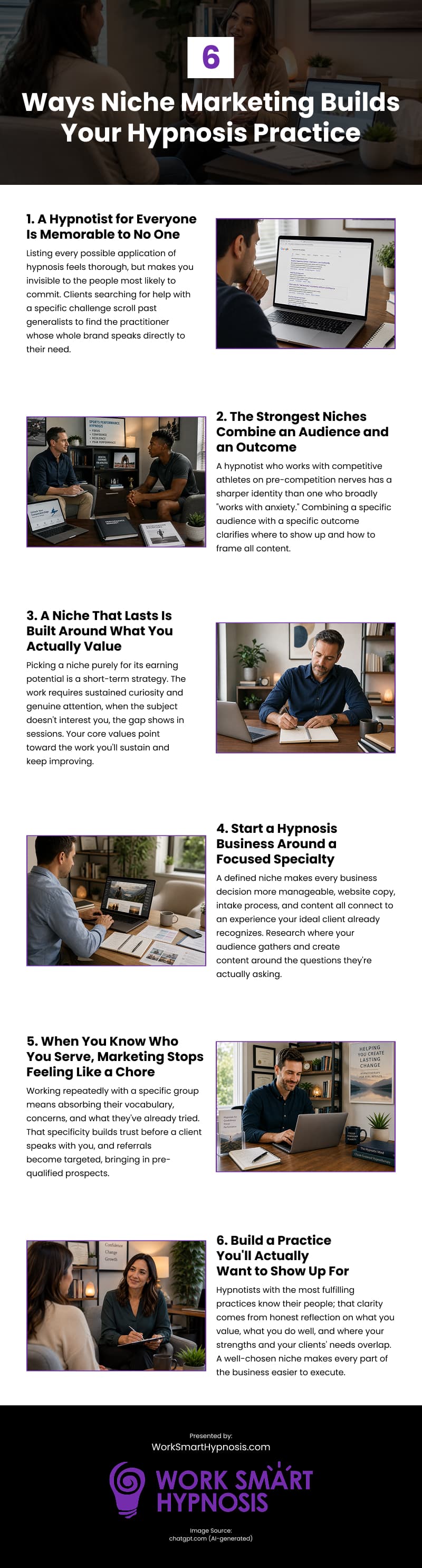
Most hypnotists assume broader appeal attracts more clients, but listing every application of hypnosis makes a practice invisible to the people most likely to commit to the work. Discover ways niche marketing builds your hypnosis practice in this infographic.