If you’re learning how to be a professional hypnotist, you’ll quickly discover that your workday rarely ends when the last client leaves. You still have emails to answer, consults to schedule, and the constant mental load of thinking about how to improve your business. Add your personal life needs, like errands to run and managing your health, and the line between work and personal life can quickly disappear.
That is why you need to treat work-life balance as part of your professional system. It affects your presence in session, your decision-making, and the way clients experience you. If your schedule stays imbalanced for too long, you’ll quickly burn out. You may still function well on the surface, but your patience may grow short, your creativity may diminish, and your ability to stay fully present in a hypnosis session may slip.
Balance Starts With a Realistic View of Your Role
Many hypnosis professionals underestimate the number of roles they carry in a single week. You’re not just the hypnotist. You’re also the brand marketer, scheduler, bookkeeper, content creator, and often the person handling every follow-up message. If you don’t account for all of that work, you’ll keep building schedules that look manageable on paper and are exhausting in real life.
The good news is that well-designed hypnosis training courses lay a foundation you can build on. The skills and confidence you develop carry over into how you manage your practice, make decisions, and show up for clients. The business side simply requires the same intentional effort you brought to learning your craft.
A better starting point is to map your actual responsibilities. Review your week’s schedule and separate client-facing work from everything else that keeps the business running. Once you do that, it may be easier to see why a handful of sessions in a day may feel just fine on some days and overwhelming on others. The session count is only part of the picture.
Protect Your Best Hours for the Work That Matters Most
Not every task deserves your highest energy. Your best mental hours should go to the work that requires the most presence and judgment. For many hypnosis professionals, that means sessions, consultations, and strategic planning that shape your practice’s direction.
Administrative work can eat up every open gap if you let it. Emails, minor website edits, social media replies, and scheduling changes can all make you feel like you’re being productive, but they can also steal the hours where you do your best thinking. If you constantly give those hours away to admin tasks, you limit how present and invested you can be in the work you’re actually there to do.
A cleaner approach is to block your schedule with intention. Keep your highest-value work where your mind is sharpest. Let lower-intensity tasks fall to the parts of the day when your energy naturally drops.
For instance, if you feel more alert and engaged in mid-morning, schedule sessions and client consults for that time. If you find yourself needing to reenergize in the afternoon, use that time to send marketing emails, return calls, or upload posts to your social channels.
Stop Treating Every Open Slot as Bookable Time
A common mistake in private practice is assuming that every available hour should be available to clients. That mindset can generate short-term revenue, but it often leads to long-term fatigue. Just because you can fit another session into the day doesn’t mean you should.
You need a transition space between sessions. This creates space for jotting client notes, decompressing, and preparing for your next session. Hypnosis work requires a lot of mental focus and attention. If you move from session to session without any breathing room, your focus will be severely depleted by the end of the day.
Think about how you want to feel in your final session of the week, not just the first one. Build your schedule around that standard. Your clients will benefit when you are steady and ready to be fully present in their hypnosis session. Doing that is much more difficult when your calendar is packed too tightly.
Build a Practice That Fits Your Life
Some hypnosis professionals create stress by copying business models that don’t align with their true priorities. One hypnotist may enjoy a high-volume schedule with short sessions and group work. Another may do better with a few private clients, deeper packages, and longer breaks between appointments. Neither model is automatically better. The better model is the one you can sustain.
This is where honest self-review helps. Ask yourself how many sessions you can run in a week while still having enough energy for your personal life, your health, and the business itself. Consider whether you want evenings full of client work or whether those hours are better used for something else. Determine whether you’re trying to build a business that impresses other practitioners or one that actually works for you.
The more your business model matches your real life, the easier the balance becomes.
Use Systems to Reduce Mental Clutter
As a professional hypnotist, the work you’re expected to remember is too much to carry in your head. You may remember a client’s follow-up question, a social media idea, a change to your intake form, and a bill you need to pay, all while trying to stay focused in session. That constant mental switching can leave you feeling fatigued even when you’re not actively working.
Systems help reduce that pressure. A simple client workflow, template emails, scheduled admin blocks, and a clean content calendar can make a big difference. You don’t need a complicated tech stack. You need enough structure so your brain doesn’t have to keep tracking every loose end.
Consider what would happen if you took a full day off from work. Would your business feel stable, or would it feel like everything depends on you remembering every detail? The more stable the system, the more room you have to breathe.
Let Recovery Become Part of Your Work Strategy
Recovery is not a reward for finishing every session and responding to every client email. It’s part of how you stay effective. If you wait until you’re fully depleted before taking a break, your work will usually show the cost first.
Your recovery can be simple. It may be that you take a walk between sessions, have one day a week with no client calls, or a set time each evening when business stops. You can also recover with self-hypnosis, journaling, or quiet time to mentally disengage from the work. The point is to move from constant output to a regular reset.
This is especially important for a hypnosis professional, as your work depends on regulation. Clients often respond to your steadiness before they respond to your words. Protecting your own nervous system supports better outcomes for them, too.
Balance Improves Business
Your clients come to you dealing with stress, anxiety, and lives that feel out of control. What you model matters. Fostering a strong work-life balance as you build your hypnosis practice isn’t just a personal benefit. It shapes the quality of care you can offer.
When you’re regulated and clear-headed, your presence in session becomes one of your most powerful tools. That steadiness is built through the same intentional work you bring to every other part of your practice. Protect it with the same seriousness you give your clients, and both your work and your life will be stronger for it.
Video

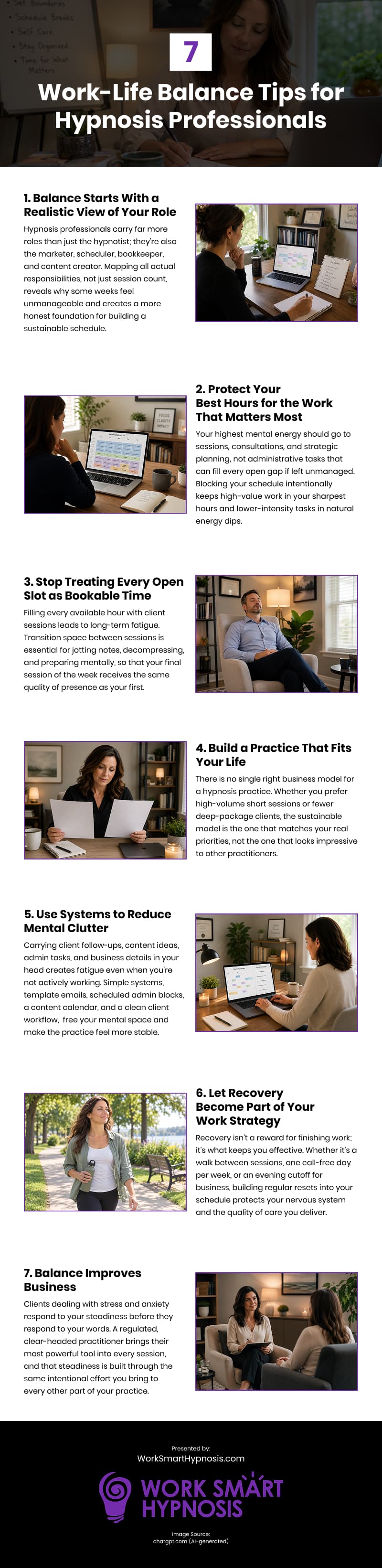
Infographic
Work-life balance isn’t a personal luxury for hypnosis professionals; it directly shapes session quality, client outcomes, and the practice’s long-term sustainability. Explore work-life balance tips for hypnosis professionals in this infographic.