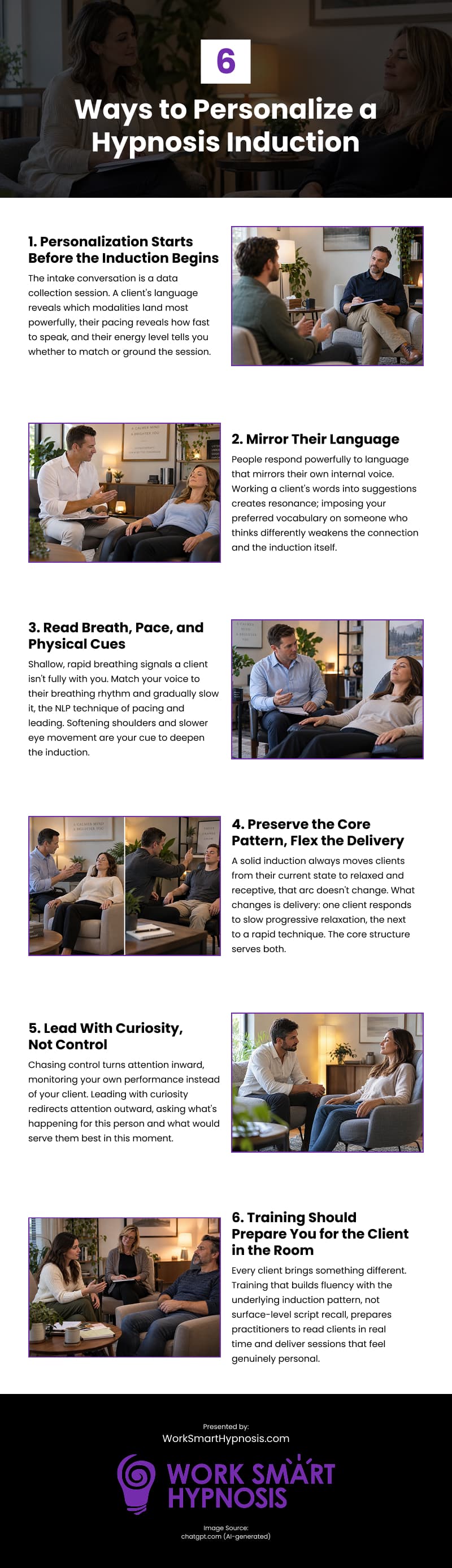
Have you ever stuck to a hypnosis script, even when you knew it wasn’t working for your client? The induction and techniques worked well enough, but something felt off. The connection didn’t quite land the way it could have, and your client left the session with a less-than-ideal taste of how hypnosis treatment works.
If you’ve ever been in this position, it’s time to personalize your hypnosis inductions. Personalization doesn’t mean abandoning structure. It means developing enough awareness to stay genuinely present with clients while keeping the induction moving in the right direction. That’s a skill, and like every other skill in this work, it gets better the more intentionally you develop it through strong hypnosis training courses.
Personalization Starts Before the Induction Begins
You may think of personalization as something that happens during the formal induction. In practice, the best personalization decisions get made before you’ve said a single word of the scripted process.
As a professional hypnosis practitioner, your intake conversation is a data collection session. Pay attention to how your client describes their experience. Do they use visual language like “I see myself getting stuck”, or feeling-based language like “It weighs on me, like I can’t shake it”? Do they speak quickly and jump between ideas, or do they move slowly and choose their words carefully? Do they seem eager to begin, or are they hesitant and full of tension?
How they respond during the intake conversation gives you insight into their needs and how you could structure a session. Their natural sensory language hints at which modalities will land most powerfully in your suggestion work. Their pacing tells you how fast to speak and how much silence they can hold before it becomes uncomfortable. Their energy level tells you whether to match them or to take a more grounded approach.
A script can’t read your client. You can, and it’s your job to mold the session to your client’s needs and reception style.
Mirror Their Language
One of the most effective ways to deepen rapport during an induction is to use your client’s own words back to them. People respond powerfully to language that sounds like their own internal voice.
When a client says they want to feel “lighter,” that kind of description is a gift. Work it into your suggestion language. (“With each breath, you might notice a sense of lightness starting to build throughout your body.”) The phrasing that may best suit your clients won’t come from a script. It comes from paying attention to how your clients describe their situation and concerns.
The opposite is equally true. If you impose your preferred vocabulary onto a client who doesn’t naturally think or speak that way, it severs the connection. The suggestions won’t land with the same resonance. Your client may follow along but may struggle to achieve a deep induction.
You don’t need to mirror every word your client uses, but you do need to demonstrate that you heard them. That distinction is what separates a technically correct induction from one that creates a powerful experience.
Read Breath, Pace, and Physical Cues
Language is one channel. Body language is another.
As your client moves into the induction, watch their breathing. Shallow, rapid breath may signify that they’re not yet fully with you. You can pace your voice to match their breathing rhythm, then gradually slow it down, pulling them along with you. This technique, rooted in neuro-linguistic programming (NLP), is called pacing and leading. It’s a practical tool available for working with a client who’s anxious or resistant at the start of a session.
Watch for physical shifts as the induction progresses. Do the client’s shoulders soften? Do their eyes move more slowly?
Trust those shifts. They’re your cue to slow down, deepen the induction, and give your client more space to follow through. Personalization at this level is all about staying observant enough to notice your client’s physical experience in real time and adjust accordingly.
Preserve the Core Pattern, Flex the Delivery
Many hypnotists believe adaptation means improvising from scratch. It doesn’t. Structure is what gives you the freedom to adapt in the first place.
A solid induction has a predictable underlying arc. You move your client from their current state into a relaxed, receptive one. You deepen that state. You build a bridge to the work you’ll do together. That progression doesn’t change based on who’s sitting across from you. What changes is the texture of how you move through it.
One client might respond beautifully to a slow, progressive relaxation approach with deliberate pacing and long pauses. The next might find that tedious and respond far better with a rapid technique that feels active and decisive. The core structure serves both. The delivery shifts to match what’s in front of you.
When you know the underlying pattern so thoroughly that you’re not consciously thinking about it, you free up the mental space to watch your client and respond to what you’re actually seeing. That’s the point where script-based hypnosis becomes client-centered hypnotherapy.
Lead With Curiosity, Not Control
Many early practitioners want to hold tight control over the induction. The fear is that deviation leads to failure. The trance won’t hold, or you’ll lose your place and not be able to recover.
What actually happens when you chase control too hard is that you create a rigid induction. Your attention goes inward, monitoring your own performance, instead of outward, watching your client. You stop responding to them and start executing at them.
Move from control to a position of curiosity. Genuinely ask yourself what’s happening for the person in front of you right now? What do you notice? What would serve them best in this moment? Those questions redirect your attention where it belongs: on your client.
Curiosity is also a strong communicator. Your clients will pick up on whether you’re genuinely present with them or simply moving through the motions. That sense of being seen and met where you are is a core ingredient in deep hypnosis. You can’t perform it, but you can cultivate it.
Training Should Prepare You for The Client in the Room
Every client you work with brings something different into the room. Your training should prepare you to rise to those differences, not just follow a set path.
When you understand the underlying pattern of an induction, you gain the freedom to shape it around the person in front of you. Your responses become deliberate and grounded, built on the structure you’ve internalized rather than the steps you’re recalling in the moment.
Find training that builds this kind of fluency, one that prepares you to read your client and respond in real time. That’s the foundation for sessions that feel genuinely personal, no matter who sits across from you.
Video
Infographic