If you run a hypnosis practice or plan to build one, the path from competent to credible isn’t always obvious. There’s no shortage of ways to develop your skills, but not all of them give you the structure, feedback, and professional foundation that a serious practice demands.
Hypnosis certification is one of the most direct ways to address that gap. It offers more than technique, giving you a framework for how you work, how you present yourself, and how you grow over time. Below are some of the key ways certification can support both your development as a practitioner and the long-term health of your business.
Certification Sharpens Your Session Structure
When you work with real clients, you need a repeatable session framework. Certification programs usually train you to think in phases, moving through pre-talk and induction to deepening, suggestion work, and emergence. That structure keeps you steady even when a client brings a complex issue or shows up skeptical or emotionally guarded.
A consistent framework also helps you avoid the common early mistake of over-improvising. Improvisation has a place, but you want it built on a foundation. By learning hypnosis through a reputable certification program, you can stay flexible without losing direction. Your sessions will feel smoother, and your clients will feel safer.
Certification Improves Your Communication With Clients
A strong hypnotist communicates clearly. That includes how you explain hypnosis, set expectations, and respond when a client asks challenging questions. Hypnosis certification training usually forces you to practice these conversations so you can handle them without becoming defensive or overly technical.
This matters during consults. When someone says they tried hypnosis once and it didn’t work for them, you need language that keeps the conversation grounded. When someone worries about losing control, you need a calm explanation that builds trust.
The result is a professional presence your clients can feel. That presence can help close the gap between curiosity and commitment.
Certification Strengthens Your Ethical Boundaries
A hypnosis practice grows faster when it runs on consistency and clear standards. That includes your boundaries. Most hypnosis certification programs cover ethics, consent, and how to avoid putting yourself in situations you cannot support.
Certification teaches you what to do when a client presents an issue that requires a mental health specialist or a medical professional. You learn how to word your services so you do not accidentally promise outcomes you cannot control. These habits help protect your clients and your reputation.
Ethical practice also makes referrals easier. Referral partners want to know you operate professionally and understand your position as a certified hypnotherapist. When your boundaries are clear, other professionals are more likely to feel safe referring people to you.
Certification Adds Credibility To Your Practice
Your clients may not always understand hypnosis. Many people only know what they have seen in entertainment. Proper certification gives you a way to anchor your credibility without overselling yourself. It signals that you invested time in training and that you follow professional standards.
This plays out in practical ways. Your website will read differently because you can describe your approach in precise detail. Your intake process becomes more organized because you’ve been professionally trained on best practices. That creates client trust and confidence.
Credibility also supports pricing. When your positioning feels professional, clients are less likely to treat your work as a novelty. They will take the process more seriously, which can improve follow-through and outcomes.
Certification Accelerates Skill Development
Reading books and watching videos can help, but supervised hypnosis practice changes things. Proper hypnosis certification programs often include live demonstrations, practice sessions, and feedback. That feedback can help you identify habits you can’t easily spot in yourself.
For instance, as you obtain your certification, you might realize you speak too quickly during induction. You might learn that you tend to use vague language in suggestions. These are common growth points, and feedback helps you correct them early.
This kind of training also improves your adaptability. You’ll learn how to handle light trance, strong trance, resistance, and emotional processing without freezing. That competence becomes one of your most valuable business assets.
Certification Supports Long-Term Professional Growth
Your hypnosis practice will change as your experience grows. You’ll develop preferences, specialties, and a clearer sense of what you do best. Certification can serve as a base layer you build on over time.
As you progress, you may pursue specialty training in areas like performance work, habit change, regression approaches, or solution-focused methods. That progression becomes easier when you already have a strong foundation in session structure and client management.
Certification also helps you build a professional network. Many training programs connect you with peers and mentors. Those relationships can support you when you hit a tricky case or want to collaborate on events and referrals.
Personal Growth Shows Up In Your Professional Presence
Even when you focus on business results, personal growth still matters. As you train, you become more aware of how you communicate, manage pressure, and hold space for others without taking on their stress.
You build patience. You build calm authority. You build the ability to stay steady when a client tests boundaries or doubts the process. These are leadership skills that improve your practice and carry over into your life outside of it.
A Practical Way To Evaluate Whether Certification Fits Your Goals
If you are considering certification in hypnosis, start by asking yourself a few grounded questions:
- Do you want a structured session framework you can rely on?
- Do you want clearer language for consults and client education?
- Do you want feedback on your delivery, not just information about hypnosis techniques?
- Do you want referral partners and clients to take your practice seriously?
If your answer is yes to most of these, certification is likely a solid step.
Certification Builds The Foundation Your Practice Needs
Hypnosis certification gives you a foundation that supports skill, credibility, and consistent delivery. You still bring the humanity. Training simply gives you the structure to work with more confidence, more consistency, and more client challenges.
Video

Infographic
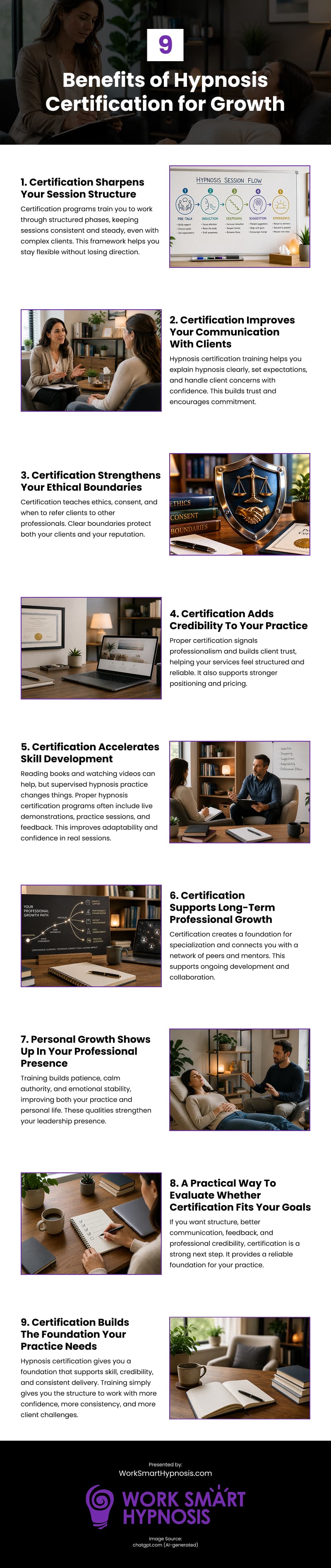
Hypnosis certification is vital for practitioners looking to enhance their skills and build professional credibility. It provides structured guidance and hands-on experience to support both clinical expertise and business growth. Learn the benefits of certification in this infographic.