Disclaimer: Transcripts were generated automatically and may contain inaccuracies and errors.
When you have a full practice, you see a big range of people who say, it’s a miracle. And on the other end of that range are people who say, oh, I can see if I keep using this tool, I’m going to continue to feel better and better. And that’s the range. And these people are both successful and so is everybody in between, depending on what our expectations are, how we’ve set them, the individual in front of us, and the techniques that we’re using as well. But the main thing is to know that everybody’s different and there isn’t a one size fits all for everything. And with that in mind, you can pay attention to your client, find out what they want, and move towards that. Through a number of different approaches, hypnosis.
Helps people take back control of their lives.
But here’s the thing.
Too many hypnotists struggle to get consistent.
Results with their clients or grow their hypnosis businesses.
I’m Jason Linett, and after more than two decades of building a thriving hypnosis.
Practice, I created this podcast to help.
You do the same. Whether you’re just starting your hypnosis journey.
Or if you’re ready to scale your.
Business to the next level, you’re exactly where you need to be. Welcome to Work Smart Hypnosis.
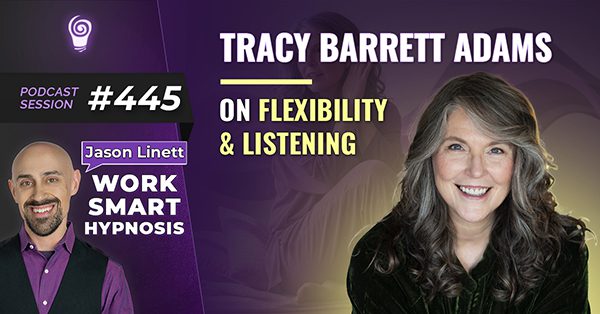
This might surprise a couple of you, but there’s one person, and really, genuinely one person, who I would give the biggest credit to for being exactly why this Work Smart Hypnosis podcast has officially relaunched. They deserve the credit, they deserve the thanks. They probably still, to this point, haven’t yet realized it, but they were actually a huge inspiration. And as to why now, we’re back after taking a pause for about a year. And you might have already figured this out, it’s my guest on the program this week, Tracy Barrett Adams, which stick around because I’ll explain everything. I’ll set the context and hype up even more how they inspired me, even though she might not still realize it.
Here, though, for you and me here right now, if you haven’t yet listened to the episode that released earlier this week, Worksmart Hypnosis podcast session number 444, go back, listen to that one before you listen to the rest of this one, because that’s going to put into context a lot of what we’re about to get into, though the actual core material of what Tracy and I talk about. Yes, it does stand on its own. So before I get into the details of who Tracy is and what she does and what she excels at, Tracy’s somebody who saw that last year I was promoting an event and it’s one that we’re going to be doing again sometime soon called the Persuasive Systems Launch. You can check out the details. The website for this is DoItNow VIP.
And that’ll just bring you over to the page specifically about Persuasive Systems Launch. Now, Tracy was previously a guest on this podcast and I’m going to make things easy for you here because all the references, all the resources I’m going to talk about. If you go to worksmarthypnosis.com 445, this is session number 445. Go to worksmarthypnosis.Com 445. That’ll bring you over to the show notes for this specific episode. So the things I’m talking about, the things that later on Tracy will talk about, we’re going to put everything over there for you. So we kind of turn the tables in our relationship. Because years ago, Tracy was teaching a workshop at the hypnothoughts convention specifically on strategies that she uses to help her clients to then improve their sleep.
And the end of the story, to shorten it, is that I found out later on I might have freaked her out because I signed up for her program and I specifically told her why it’s that I said, you are teaching something that I could use some better strategies for. So because this is something that you do better than I do, that’s why I’m going to pay for your training. I’m going to sign up for your class. And there’s actually a bigger story around this because that was a year that, as far as I heard, I was teaching a post workshop at hypnothoughts Live. And I was the only pre and post presenter who also paid and signed up for another workshop for me to attend. I didn’t try to drop any ego.
I didn’t try to, you know, trade or barter my way into the event. No, I paid for it because I wanted to value the work that she was doing. So let’s fast forward the story and Tracy’s someone who I already knew was a force to be reckoned with in this industry, did great work with her clients. Did great work. I’ve actually referred clients to her over the years. And she saw this invite for Persuasive Systems Launch and she reached out and eventually, this is not revealing anything too private. Eventually we kind of figured out that it had to be a custom project where basically me and my Team, were going to rebuild every one of our websites. We were going to streamline the way that her information delivers and along the way find the places where profitability was being left behind in her business.
So I share this with you because here’s someone who I already saw was a fellow leader and she reached a place where she thought to herself, and this is my take on the story to go, hey, here’s someone. This is going to sound familiar. Here’s someone who does a thing slightly better than me. Let me work with them to see what they know. So at this point now, the websites of Tracy’s that you can find, depending on when you listen to this episode, they’re either the variations that we helped to rebuild. Though the big part was the behind the scenes automations of it. And here’s the part that kind of brings us up to the current timing and really became the inspiration. And this is a big part of the conversation you’re about to hear Tracy and I have together.
We are very clearly in a different world right now. The way that people communicate with each other, the ways that we treat our money. And she’s someone who, like many others and some of you out there, reached out to me as someone who talks about business and basically said, hey, here are the things that have always worked and they’re still working, but just not the same way that they did before. I’m having to push more, I’m having to hustle more. It’s taking more effort. What’s different and a big part behind the scenes as to what needed to happen with Tracy’s projects, which is the thing that I find is true with most people is that we get caught up focusing only on the new audience coming in.
And one of the biggest places where you can fix some of the most profitable gaps in your business is to maximize the people who are likely already finding you and not yet taking action. So that’s a big part as to what I teach and what I consult on the attract presale client side of my world and why we also now do website projects and funnel projects as well. But this inadvertently became the spark that I needed because she got to a place where things were already going well and then looked at it and went, something else needs to shift and I’m not seeing what it is. And personally, let me take a few more moments and make this introduction only about me a little bit further. Then I’m going to tell you more about Tracy.
It’s that I saw that I heard that we had those conversations we started to work with each other and we’re still continuing to work with each other on a few other projects here. But it’s that I looked at this podcast and went, yeah, it’s not just restarting it. It’s not just inviting a different type of person onto the show. It’s not just teaching different things. It’s not even the things that I offer that has to shift. It’s that we need to change the communication of it. And that right there. Go back and listen to the last 15 or so seconds again. That right there is one of the biggest things that needs to shift.
So in this conversation that Tracy and I are about to have with each other that you’re about to listen to on flexibility and listening, we spend a little bit of time talking about not just, you know, the thing that’s kind of become the norm for a lot of us. How do you run your business differently as a hypnotist ever since the pandemic? Well, this is probably the first time that I’ve recorded a genuine long form conversation about what are the long term effects as to the world that we’re now in? You know, post Covid post, a lot of us then migrating online, what are some of the different things that are occurring in terms of the mind of our potential clients, the people who could likely buy from us and then invest in our programs and our services?
What are the things that need to change about just how we communicate to bring people in? So we go deep into this conversation. We go deep into what is it you need to be aware of. And this is no longer just the conversation as to, hey, here’s what’s different. You got to be aware of it. No, we break it down and we’re going to get specific with you in this conversation about the communication shifts that need to occur to better engage your audience so that you can grow a new audience even in this changing landscape of not just who our clients are, but also how we’re all different people at this point. The world has shifted. So many things have changed.
And let this conversation be a marker in time to realize that, well, what worked before isn’t clearly working the same way right now. Related to that, Related to that. A big part of this conversation is going into themes of how we personalize for our individual clients. The more that you work as a hypnotist, you’re going to find that there’s more systems that you kind of, you know, develop of your own. Here’s what I do for this. Here’s what I do for that. Yet a big part of this is just the way that we can better, I love this term. Bring our clients into their own sessions. How do we get them deeply and thoroughly engaged in the work that we’re doing so that now it’s no longer a theme of fingers crossed, hope it works, let me know how it goes.
Instead, how do we create these moments of proof? How do we create the space for the change to occur and the change not just to only occur, but also truly to lock in? So we cover quite a bit, as I promised in the previous session, these new episodes of the Work Smart Hypnosis Podcast, we go deeper into the things that really move the needle of our businesses as well as change. We’re going to talk about the evolution of medical hypnosis, how even that’s a different world now, as well as just how do we stay flexible and how do we stay open to change, and just how do we keep improving each step of the journey? I’ve said this next thing for years. Don’t be the person who points at an old thing and says, that doesn’t work anymore.
Instead, ask yourself, what parts of it work, what parts do I need to modify, and also what parts truly are important. Now, one further thing about this, there’s a theme that pops up in this session, and make sure you listen all the way through to the end, because I’m gonna do something special with all of you here. But there’s a theme that is one that I’ve often been cautious to share on this program. I’ve even been cautious to share it in my own training events. But it’s the ways that you can maximize this magical window of time that occurs not just at the end of your session, but the time that occurs right after the end of your session. And Tracy shares something absolutely beautiful.
And it’s probably one of the greatest side effects, we’ll phrase it that way, this way, it’s probably one of the greatest side effects of what has occurred as so many of us have migrated our services online and we’re now seeing our clients in their own homes, in their own offices, through webcams and online video conference. So stick around to the very end. Listen towards the end of this conversation because it is just magic of one simple addition you can put into your session. To take the work that might have worked and make it truly lock in. It is phenomenal. I have personally gone through a ton of Tracy’s material because, well, I’ve taken her trainings before.
In the last year, I’ve helped to migrate and move and improve upon a lot of what she has shared and just help to change the user experience for the people who go through her trainings. So I can personally vouch for it. So the show notes worksmarthypnosis.com 445 Go check out everything she offers. It’s all good. Sign up for it. It’s outstanding. You’ll find all the details [email protected] 445 place. And again, listen to the very end of this week’s session because there’s a special moment that I’m going to share with all of you. So here we go. There’s a reason why she is the very first guest back after a one year pause in doing this program. This is Work Smart Hypnosis podcast session number 445. Tracy Barrett Adams on flexibility and listening.
Now for longtime listeners of this program. I had Tracy Barrett Adams on the program back in January of 2019. So it’s kind of perfect timing that what are we now at this point, like seven years and a couple of days. So, Tracy, welcome back to the show.
Thanks. Great to be here again. Doesn’t seem like it’s been that long.
Yeah. And one of the sort of impulses behind this conversation is in one part for this audience and I’m gonna call it out myself. And one part also here for me, which is that a conversation that I’ve been kind of laying the foundation of for a couple of years and something that I saw you swoop in and beautifully address is that the audiences that are online, the people who are our clients, and for you and I as well, our students, I kept referring to it as market sophistication and places where people were responding to content in different ways.
And you’re someone who I saw in the last year, notice that, and then do things about that, though, before we get into that theme, for those who don’t yet know you, could you share a little bit more about who you are and the work that you do?
Sure. I’m Tracy Barrett Adams and I am a clinical hypnotherapist and have specialized in what we would call medical hypnosis over the last 15 years or so. And now gone from my brick and mortar office to working exclusively online and also do quite a bit of teaching. Now that is probably now two thirds of my practice is teaching practitioners, hypnosis practitioners, different things, including medical hypnosis and a few other topics that I have particular interest in and the range of things now that are available, and the number of new hypnotherapists that have come into the world as a result, I think maybe of just the way that tides changed in careers during the pandemic has made that really something that I’ve been really enjoying serving a lot of people in that way.
Yeah, well, let’s actually rewind that back a bit here, because the impulse to then move everything online. Where did kind of the origins of that come about for you?
Oh, well, it was really a surprise. I was working online with some clients for some things for a long time. So I do a lot of work with fertility and a lot of work with sleep. And so those are topics that I would speak at conferences about. So other practitioners in other. Before 2020, other practitioners in other parts of the country would refer clients to me. And so I would work with those people on Skype and on. When Zoom. I didn’t even actually know Zoom at that point, but it was mostly Skype. And what I found with those clients consistently, again and again, was that they made progress more quickly and more efficiently than the people that I was seeing in person. Not by a huge measure.
But, for instance, my default for how many sessions we might start with for a certain issue might be six sessions in my brick and mortar office. But I found that working online, we often just didn’t need that six session. So when the pandemic came.
Well, let’s pause there for a second because that’s that interesting point you just hit there. If you could kind of unpack it and decipher it, like, what would you say was the difference as to why they were more responsive online?
Well, my thought at the time when I was working with these people in Florida and New York was that they were just super gung ho, and that was fueling some of the process. But when the pandemic came and everybody went online, that same effect carried over. And my thoughts about it were kind of evolving over the first six months of that. And I think that one, people loved my office. I had a beautiful office. It was really had a nice aesthetic. And people would come in and they’d say, oh, it feels so good to be here. And people would go away and come back and say, oh, it feels great. And I really feel like to a certain extent, they associated their change with my office and with my space and being there. And that when working online, they associated it within them.
When some of the first clients I saw, they were in their laundry room with their toddlers, running around upstairs in the pandemic and resolving their IBS issues and much more quickly than I think they expected to. And some people didn’t expect the best from that process working online and found that it was incredibly effective. So that’s one element, I think, also just the capacity to stay and dwell in that post session kind of thought process and to digest things a little bit, I think is helpful too, because in Seattle anyway, you have to race over there, find a parking place, which is an adventure in itself, and then leave in the rain and rush back maybe to your office and try to get there on time.
And so working in a situation that’s just less pressurized in that way or requiring people to jump back in less quickly makes a difference too.
That’s something that I’ve not really heard many people talk about in our industry. That time afterwards to kind of, well, to use one of my favorite words here, the time to kind of marinate in the change versus I have now perhaps whatever style of work addressed this thing that’s been this long issue. And then now it’s two o’, clock, I’ve got to head back to work, I’ve got to go back to that meeting and I’ve got to kind of go through the routine of the day. And it’s one of those things that I couldn’t ever be the person to tell everybody, hey, take the rest of the day to yourself. But you’re right that in that online format it’s a lot easier, it’s a lot more organic for that to happen without overtly having to suggest it.
Right. And I give people things to do between sessions. And we would have to have a whole discussion in sessions in brick and mortar about when are you going to do this and how are you going to make this happen. And when they’re working online, I’d say, I want you to take 10 minutes after this session, write these things down and consider when you’re going to do these things and let me know if you need any support with that. The rate of people actually following through is so much higher now than it was with us just doing all the instruction and then completely changing gears.
And I love that you did reference the fact that maybe it was in one way prestige suggestion that here was somebody who, well, as I’m now thinking back to the way that you explained it a moment ago, here’s where I sent you referrals at times to go. Here’s this person who I think years ago I kind of freaked out when I signed up for her class.
Yeah.
You did that better. So it’s like, let me see how Tracy does that. And it was a timeframe where I think that might have been when I was moving. And it was like, well, here’s the person who I learned some of these strategies from. Call her yet. It’s cool to hear that sort of. When that prestige suggestion element of it fell away, the results still stuck. And I’m right there with you on that. That my story of the sort of epiphany of moving more things online was when I was in Alexandria, Virginia, and someone from Annandale, Virginia, which look it up on a map three miles away, that’s a 45 minute drive if you’re lucky. And it was the timing of it. And he goes, well, my issue is that I’m losing confidence in doing settlements.
As a lawyer, if I’m in the courtroom, I’ve got the adrenaline of it, I’ve got the energy of the event. He goes, it’s the song and dance show. If I’m in the settlement room, then it feels more raw and just I’m uncomfortable. And he’s the one to go, hey, what if I do the sessions in that room? Would that be helpful? And I went, oh, yeah, let’s do that. So, but it’s interesting to hear that not just for the sleep issues, also for ibs, other medical issues too.
Oh, yeah. My whole practice is online and I found that overall all of these things are in the online context. It’s just a little bit different. Management of the session, I would say.
What do you mean by that?
Well, a large part of the way I would manage my session when people would come in was the beautiful aesthetic of my office. And I would gather people’s impressions of that and we might even talk about that a little bit. I mean, I wouldn’t brag about my beautiful office, but just people would come in and say, oh, I love that painting or something.
You wouldn’t brag about it. You’ve already said it like four times, though.
Well, I do. I will say that is the one thing I missed. And right before the pandemic, I had just moved to an even more beautiful office with a view of the water, which is something in Seattle. So anyway, I found that my old paradigm working in person was based on something that, I don’t know, just it fell into place over the years of developing. How I ran a session was that people would come in, they’d go through the waiting room, maybe wait a little bit, kind of adjust to the space, get a cup of tea, and then they come in and sit on my love seat. That was very comfortable. And we’d talk and do all of the rapport building and pre talk.
And while were still in that space, I would do a little pre hypnotic focus exercise and then say, okay, now we’re gonna do the hypnosis. And then they’d come over here to the recliner. And that’s essentially the framework I learned when I was first in my training. And I just carried that over and I really enjoyed that format. And obviously I’m not doing that in working online. And so I will dive just right into, after a very brief preliminary, just taking people through that pre hypnotic process and have found maybe that’s also one of the things that makes the session more efficient too, is that we’re getting down to business a little bit. People don’t have to adjust to a new space or to me as much.
Yeah, yeah, absolutely. So then making that transition in that journey and from there, like, what are some of the bigger things that you’ve noticed as a result of now being primarily online?
Well, my life is easier in terms of my practice.
The background behind you right now is clean. I’m not going to ask about what the table surfaces.
You should not ask about that.
Okay, yeah, same here.
Same here for sure. And the flexibility that I have that I can work from different places and that I can be paying attention to some things that I didn’t have time for when I was supporting a beautiful office, a beautiful aesthetic office in Seattle. I had to just keep my practice all the time full and teaching a lot of classes as well to. To clients. I taught childbirth classes in fairly to fairly large groups. And that has been. I would heard somebody, maybe it was you. I heard somebody say about the pandemic is that we don’t wanna be opportunistic about it, but there was an opportunity there for me to say this is a good transition from my practice as well.
I’m laughing at this because you and I were having a chat about fighting with cloud storage and I’m migrating some things from Dropbox to Google Drive and it’s actually on my side computer over here. But the name is blocking out and it’s bothering me that I can’t see the name. I did a workshop with him in 2020 about brain science and copywriting. The name will come to me as soon as we’re done. But it was his statement that you should never take advantage of people, yet always take advantage of the opportunity.
Right. So that’s what I heard that sometime it’s soaked into my consciousness because it did seem for years I had been wanting to have more flexibility, but it just didn’t seem like that was possible with the way my practice was. And I loved working full time. I loved seeing a lot of clients. It’s energizing and wonderful. And it just was limiting in terms of how many people I could see. And also moving into more of the teaching sphere, it meant I could really only do one thing at a time. And now I can do a number of things at a time.
Yeah. So then kind of getting onto theme that I was introducing earlier then, at what point, let’s say in the last couple of years, did you start to notice a bit of a shift in terms of just sort of the tide of people coming in, the tone of people coming in.
Boy, that was January of 2024, I believe January 2024. And it was abrupt. There had been through the whole move online and through the pandemic, no interruption in my practice except for the first six weeks where we first shut down before we realized, okay, with something that we’ve got to carry on here online. But the shift that was very dramatic was in 2024, January of 2024. I’m used to the ebbs and flows and lulls that come around September or August and December and then get really busy in January. And I have long had ways of balancing that out with some group sessions and things. And boy, that just didn’t happen. This January just didn’t come. It didn’t surge back up. And then. And I thought, well, that was interesting. And I can tell you the whole story.
In my case, it may not be a reflection of everything else that was happening in the industry. There was a little perfect storm of one thing after another. But then it just was clear that the. Somehow the. The field had changed and there were fewer bookings on for new client bookings, which I still, as much as I’m transitioning to reduce some things in my practice with client flow, not that much.
Now, when you say the field was changing, do you mean that in terms of the hypnosis industry, the field of people coming in?
Well, this was a mystery for me to figure out. I didn’t know. I mean, I knew there were some things that were directly affecting me. Like, for instance, my. The very large corporation that lets people know that you’re here, like on a map on the Internet. Yeah, they. They canceled me. They said, I, you don’t exist. And so I didn’t realize that had happened. They sent me some emails and Said hey, we’re gonna cancel you cause we don’t think you exist. And I was getting so many emails from them every week and every day I just eh, I didn’t even see that one that said he appeal this. And then I couldn’t appeal it anymore, the time had passed. So that was one factor for me that was of direct impact. And so I have thought that was the only factor.
And so as I.
Well, just a quick little thing off of that and I’m not going to say the name but did it rhyme with help?
No, it rhymed with. It wasn’t that rhymed with boogle.
Okay, yeah, got it. Which I mean there’s a silly thing just to throw this out there. And again, this is not for the purpose of the. Oh, you should have done this. Because it’s easy to say that now there’s this small sort of mundane task that I’ve learned the importance of doing. And I wish I was the person organized enough sometimes to say, oh, I do this on schedule. I have this on the 1st of every month. No, the same way that it’s in my calendar to change the air filters in the house on a certain schedule, it’s gonna happen that week. It’s not gonna happen the exact day that I’ve put it on the calendar, but just the importance of taking. Pull this off in 10 to 15 minutes and go to all of your websites, make sure they actually load.
Go to Google yourself and see what pops up. And I mean I was talking to someone who, she’s a realtor who is moving into hypnosis. And the thought was, oh well, I don’t want to pay that bill for this online service this month. I know that they’ll keep it active for a couple of weeks if I cancel it, but then I can renew it and everything will still be there. No, it wasn’t. So just the importance of just having that little bit of housekeeping to check in.
Oh yeah, well, yeah, now you’re preaching to the conversation.
Easy to say no.
Yeah, right.
Yeah.
So for sure that had just not occurred to me that could happen. And so if I’d known it was even a thing that could happen, I would have probably opened those emails. But as it was, I was recovering from that and had a pretty. Just needed to reestablish myself and come back from that. But it was not just that. I noticed that in forums, some of the groups that I’m on Facebook of nurses practitioners, that this was a theme that was coming up like all of a sudden something Shifted and changed and there were fewer calls and fewer bookings. And my experience has been that the things ebb and flow a little bit, but this was a pretty hard ebb. And that seemed to be not just me.
And I don’t think it applied to every person, but I did realize, well, there’s some things that this. Because this seems to be a shift that may have to do with algorithms or it may have to do with some factors I don’t know about. I needed to do something to make a change. I was not ready to just go with the flow, which in my practice, honestly with marketing or anything like that, for all of the years that I’ve worked, I have just been able to be, to exist and have people find me and enough to keep my practice full time. And that was.
I’m trying to rewind back in my head because like you had said January 2024 and I think it might have been like as early as 2020, like late 2022 for me that I was starting to talk about themes of just hey, something’s coming in terms of. And again I keep, I kept attaching the term of market sophistication, which is that especially now with the massive outburst of everything AI and information on demand. And there was this epiphany that I had a couple of years ago which was that I bought a book, it was $30. And then eventually with that specific company, that specific educational organization, I eventually joined their mastermind and paid them $50,000. And then when I asked a question, they go, oh well remember in this.
Specific book, I think that’s either chapter.
Seven or chapter eight. And it was in that moment to go, oh, that’s right. The ascension of sales doesn’t just have to be about now you’re getting the real secrets. It could just be about levels of access, the difference between telling someone what to do versus telling them in real time and customizing it to them versus doing a project with them or doing a project for them, that the funnel based sales ladder can change based upon levels of access and levels of support. So I was seeing as early as like probably November, December 2022 that the market was shifting. And this was across other areas too of how information. And now you’re getting the real secrets. That message wasn’t quite working the same.
And it’s kind of this, in my opinion after effect of the pandemic where there was this novelty of now everything can go online, but. But then everyone else went online and along the way some of us had incredible experiences as consumers, some of us got burned a few places. And the place of automatic.
I’m thinking back to it.
What was it? There was a video of Igor Letta Hoskies that I watched at one point, and he went off into this beautiful metaphor about how there was something he said. And this is an older video where he was talking about how the moment you see a police officer, you attach a level of authority and respect to them automatically. And I was watching this older video of Igor’s the week that they were marching in the streets because of George Floyd. And I went, oh, that’s a sentence that doesn’t work the same anymore. And just. So it’s where it’s not that it’s better or worse, it’s different. And I was getting calls from people as early as 2023, hey, what are you doing? Because, like, what I was doing before, it’s kind of working. It’s not working the same.
And I think it was like March 2023 was the first time ever that I sent an email out for something that was something that always worked the same, always was reliable.
And.
And then in a span of like a week, no one took action upon that email. And I went, oh, that’s different now.
Yeah, I had that experience as well. January of 2024, I have for years, in my little slow moments, I send out a little notification that I’m going to do a little retreat. And I’ve done. Some of those are six weeks, some of those are three weeks. And it’s priced. It costs about what a session costs, but it’s really rich with material and you get lots of recordings and it’s really good. Anybody who’s worked with me wants to. If they want any kind of a January refresher, they like to do that. And even if they don’t show up, they know they’re going to get some stuff that they’re going to use. And that has been my January, like, take some time off, the way I pay for having taken some time off at Christmas.
All reliable.
Yeah, for years and years. And I put that out there and I was like, so this has nothing to do with whatever was happening with my online profile. This was just something to do with whatever was happening. And a few people signed up for that. Unlike what it would typically have been before I was. I kept thinking, did that email go out? I’m not an. I have not been. I’m working on this. But I have not been a proactive email communicator with my client base or my potential Client base. I have been more just, I would say, well, kind of passive, but letting people know when something’s happening but not pursuing them for it and but that has for that particular event, whether I’ve done it in the summer or winter, whenever I’ve done it’s always been just one email. Boom.
A lot of people sign up for it.
Yeah.
And not this.
So kind of shift the tone here because the whole purpose of this wasn’t to go hey everybody, market sophistication, try harder. No, it’s that part of the reason why as I took a pause from this show and no pressure, I specifically reached out to you to say, hey, you’re going to be the first interview as we come back. Good to have you here. It’s because I saw you as somebody who rather than go, it’ll go back, I’ll just wait this one out or blaming the audience as I saw others do to go, they don’t understand and they just doubled down on the exact same thing and they got double the same result, which was not good. You did things about it. So kind of walk us through some of the changes, some of the adaptations, some of the shifts that you did.
Well, it’s been quite a bit, but I would say last in 2025 I had been doing all of the things that I reest I had, excuse me, 2024, I limped along for a while. Then in the summer of 2024 I had re established a new Google listing and things were a bit better, but not where they had been. And that’s when I really realized something big has changed. The things that I’m doing that I’ve done have not working. So what do I need to do differently? And started looking for what things I might do differently. But I knew it had to do something with people knowing I exist in a way that doesn’t seem to be or reaching people who are interested in this kind of thing.
So I started looking at also the amount of structure that I had that I needed to support. Not a brick and mortar office, but I had multiple websites and a sort of pasted together conglomeration of different tech support things that you can use my word, Frankensteined together that I had over time. Not I’m not the most tech savvy person but I over time can like figure out how to put some things together. And I had put all this together and it worked. But it was paying $99 a month over here and $45 a month over here and $35 a month over here and $400 a month over here. So it was costing at this point as much as my brick and mortar office had almost.
And so I wanted to reduce that cost and I wanted to simplify and I wanted to improve the way that I was communicating online. And so I started looking at different kinds of courses and how do I do that in a way that feels organic to me. Right. How do I feel like converting from a person who doesn’t like to be salesy, who doesn’t like to tell people, hey, I’m doing a thing that you might like to being a person who says, I think you’re gonna like this. And I do mean it when I say that. But it was a transition for me and so I looked at a few different things and I ended up signing on with you and your. One of your programs that.
And I’m gonna be honest here, I think every one of your programs sort of sounds the same to me. I don’t know what any of them is doing, but I looked at the details of what this one was doing, which your post was that I responded to was how would you like a set of pre written emails or something to send clients? And then I ended up from there. You did an audit of my website. You did a. You took a look at it. And I have had the Same website for 10 years that I keep up and I feel really proud of it. I thought it was really pretty and said a lot of good things.
And you went through kind of piece by piece, just really simply made me a little video about 45 minutes long, I think that pointed out page by page, all not so much what I was doing wrong, but things that would help people see what I was saying better, whether that was things to highlight or things to maybe move to one from one page to another, some things to expand on, some things to maybe get rid of some of a wall of words I might have had on there.
So which if I could swoop in, I’d just kind of point out two things here that were the big shifts from what I saw. One of them was that we all can fall into the trap of expert speak, where we end up speaking about the things that we do, the ways that we always speak about them, the ways that I’ve said it ever since. Episode number one of this show, which is that I built Everything Works Smart Hypnosis aimed for the hypnotist who already does hypnosis. That’s who the intended audience is. Now the message, the podcast goes out to a much larger crowd. I can look at global unique downloads and go those can’t all be my demographic.
But we can fall into the trap.
Of talking about things the way that we would let’s say in a training versus the marketing terminology is top of funnel communication tofu top of funnel where it’s now speaking to the audience in terms of their problems, their hopes, their goals, their dreams, their desires basically what’s their conversation, what’s their narrative. The technical part of yours was something that I consistently see is nearly everybody’s issue and it is in my opinion the number one solution to this market sophistication thing which is that we end up focusing only on new audience acquisition. We end up focusing on how do we bring more traffic in, more people in which yes, that is important.
Yet at the same time here’s the number of people who are already discovering us and the way that most people attempt to run their businesses is kind of this fingers crossed, hoping they take action the first time versus planting those seeds so that now we have a means to keep in that communication. So how do we optimize more of the people coming in and not just continuously try to throw new people at the existing stuff?
Well and my feeling has always been negative about anything that’s pushing somebody to do something that people will come when they’re ready. And then if I’m pushing sometimes I hear people talk about how to bring a client in or how when in that conversation to help them recognize how great this is going to be for them. I don’t I just say this is what it is and what’s your what’s going on with you and if it feels like it’s a fit to me then I will say what it might look like for us to work together. And then I say and then when we get done with that if you want to we can look at the calendar together or you can think it over and that’s as far as it goes.
Most with that approach which is very passive I might say probably 90% of people that I’m interested in working with who call book to me great numbers. That wasn’t broken. It was I didn’t nothing to fix there.
But still there’s a number of people who were kind of sl I had to if you saw my eyes darting to the side here I was opening up a template of mine versus a part of your site where my language was Please share your email address to get access to my calendar and I just love that yours shifted to Please share your email below to view available times and Schedule your free consultation. And I just loved that as a quick moment to go. Both are basically saying the same thing. But it’s the importance of how it feels to us.
Right.
And some of it, okay, let’s just go like 12% limiting belief here. Some of it becomes the. It’s not that people exit the process because they’ve decided they don’t want it. Sometimes it’s as simple as. I mean I was going online to buy something yesterday and it was the silly moment of going oh let me grab my Capital one credit card that I typically use. Oh wait, that’s right, they just mailed me a new one. I think it’s in the envelope that’s on my desk, right? Oh wait, no, it’s in the kitchen, I’ll do it later. And I bought it today cause I forgot about it yesterday. So just we sometimes start something or just the simple phrase of life gets in the way and the polite follow up being a part of that.
I’ve noticed over the years that it’s been several people who have become clients who’ve said yeah, I’ve been looking at your website for years.
Yeah.
And on the one hand I’m glad they waited till they were really ready. On the other hand probably most of them usually say oh gosh, sooner and or why didn’t I do this sooner? Or why doesn’t everybody know about this? And I think that the practical element of presenting things on a website in a way that helps people have a greater understanding rather than being just intuitive about what I intuiting that they’re a fit for me that shift has made a difference. And I think that having just those little mechanisms in place that yes are encouraging without being salesy and that has made a huge difference. And I would say that things are now for me at a level where I want them to be again. So nice congrats on that. Thanks.
Which I mean even one specific moment to get into. Here was where you had on a training page like a list of all of the things that people would learn. And then I think it was actually an event this week where I revealed I go here’s all I did. But it was the aspect of here was the list of things. And what my suggestion was to go and was to kind of use that list of things as like the subcategory headers and then just put a description underneath it. It’s two little things about assumptions. Never assume everybody has already seen everything you’ve already done. But then also never assume that I’m Laughing because I’m recording this audio and video at the same time. And my little ear pod for my feedback here fell out of my head when I was saying something.
I go, this part’s good. We can use this later. Listeners at home on audio only, enjoy that visual moment you missed one more time here. We’ll keep it going. No, never assume everybody has seen everything you’ve ever done, but also never assume that everybody attaches the same meaning and value to the same things that you do.
Right?
And that was what this moment was to go, let’s just go in and underneath each of these little bullet points, put a little descriptor underneath it so that now we can tell them the classic, here’s what’s in it for you.
Right? And I. The balance of when trying to convey value is knowing where that line is between giving people an overview that’s a quick shot and what resonates with them, and a lot of words that they may or may not feel like they want to read. Nevertheless, I started paying attention to what is it that I read and how do I process what I’m looking at different things. And I think that people are also treating their money a little bit differently than they did. I think that is also part of the shift that’s changed. I think there’s a bit of uncertainty about things and in the world and in the country, and I think that people want to know a bit more about what they’re getting in my mind than they maybe have required before.
So.
But for instance, on the Hypno Mothering website, which is the one we’re talking about, where I’m describing these kind of bullet points about the fertility and the childbirth and so on those bullet points, once I saw how you elaborated on them, the bullet points alone just no longer made any sense to me, which really surprised me. But I had written them 10 years ago, and the program is still. The program has interestingly been updated several times, but the description has not been updated.
Well, again, the conversation of, hey, the stuff that I was doing isn’t working the same way that it did before, Right? And that willingness to kind of raise the hand and go, okay, something needs to shift here. Which the simplest part of this is just two little words. So that. And this is not necessarily an example on this page, but it’s the one that I always reference whenever I’m talking about this. So that. Which is that as hypnotists, we might have on our website, that as part of the process, I’m going to teach you self Hypnosis. And for most people in our shared industry, in our shared space, that’s where they would stop. They would just say, I’m also going to teach you self hypnosis. And then they’d move on to the next point. And we get excited about that.
We love that we might go, oh, which one? Oh, that one. Oh, that’s a great one. When instead we need to put the ownership toward the potential audience as to what value it’s going to have. I’m going to teach you self hypnosis so that you have the ability to strengthen these changes long after we’ve worked with each other.
I also think that giving people that benefit, it’s laid out when it comes to something like self hypnosis. I really feel like there used to be more of a fascination with hypnosis and people just have had a lot more exposure. Now in my mind, that’s. I feel like people can educate themselves. They have Google, they have AI I very rarely have somebody come into a consult who has no idea what hypnosis is and doesn’t know. I don’t have people asking me some of the questions about things that they’ve heard about hypnosis. They come in to that call sometimes with some questions, but they are coming from a place where they have a little bit of knowledge about it.
And I think that the just the thing in the air about self hypnosis and about the kind of tool it is, people need to know the next step. Not just the, this is fascinating and interesting, therefore I’ll do it. But, like, this is kind of interesting and this is what it will do for me. And I think that rapport of having people understand this. So that wasn’t there before. To me, in my mind, I. Giving people the. The little kind of whisper of interest would then prompt the next question. And I feel like we just have to kind of answer the next question now. I mean, that’s what I feel the benefit of that is.
Well, it’s again, back to that sophistication, back to the fact that information is no longer the same commodity that it was before. Information is more easily found. And here’s an event that I went to a couple of years ago that was an event that I was kind of deciding to go, hey, I think I’ve gotten from this group everything that there is to get. I think I’m just going to do this one more year and then wrap it up there. And what happened was, at this event, for the first time ever, I saw them get up and over the course of several days just blatantly give away every bit of every step of their program, like detail everything. And I’m watching and going, they’re going to do a sales pitch at the last day. How are they going to handle this now?
And the shift was what’s going to happen when you’re now back home and back to your regular routine? And how many other things have you learned that you never implemented? Versus here’s how we can help you to get this thing done. And I mean, I’ve never seen that big of a rush to the table in the back of the room of people signing up for that consulting because it’s where, again, the information age, everything’s at our fingertips now. We can find things even faster now, which to make a bit of a transition here, information as well as experience. It’s where I’ve pointed towards your integrative Medical Hypnosis course for a while now, and I know that you’ve made some changes to that over time. Have you seen anything in terms of. Let’s start with the client work.
First of all, what have you noticed, if anything, different about the work you’re actually doing with clients in terms of some of these more medically related issues?
Well, in terms of my work with clients, I would say the focus of the website, of my website, Tracy Barrett Adams Integrated Medical hypnosis, hypno mothering and do I have something else?
But tracybarrettadams.com, oh, Seattle hypnomorphing.
Yeah, So I got Seattle hypnotherapy. So I got four. I knew there were four, therefore. So what I found is that which.
For transparency disclaimer, you had joined on for an event. And towards that, we also then made it a bit of a custom thing as my team kind of went in and rebuilt a number of things, connected all the pieces together.
Yes.
Got you down to one membership website rather than four, right?
There were three.
Well, there were, yeah. I mean I was on a whole teaching platform too. I had a whole other thing that was. It was unteachable, that was fine, very expensive. And I really will say that just to take a side and bar to say that in terms of teaching platforms, I really prefer the one that I’m on now. I really feel it is so much more pleasant user experience and more pleasant for me to work with too.
So.
And because it integrates with everything else. But anyway, what’s the question? What’s the difference between client work. Client work is in terms of bookings and calls.
I Get I’d say more so of actually what’s happening in the sessions.
Oh, in the sessions, yeah.
Have you noticed any sort of a tone shift of working with medical issues with clients?
And are you talking about the. As it relates to the shift in what I’m doing with my website and so on? Is that.
Well, more so because I know, pointing towards the integrative medical hypnosis course, I know that’s material that you continuously evolve and shift. I’m curious if working with actually clients with these medical related issues, if you’ve kind of noticed we’ve talked enough about sort of economic shift. Let’s talk about just in terms of personality and how people handle medical situations these days.
I would say that movement among the client work has been following a. A path all along of their people feeling frustrated with their medical resources or people who are just creatively trying to explore something new and different. Because the work that I do comes at. Everything’s all related to your nervous system. It’s all the unconscious mind is where all of those involuntary things are housed. I haven’t found that in working one to one with clients that there’s been a shift in the work itself. There’s often a shift in what they’re coming in with and how they are presenting. Coming in used to be people coming in, they heard a vague like reference to hypnosis or they looked into it, they heard of. They maybe heard of it, but they really wanted to explore what it was and learn more about it.
And I had to do a lot more pretty explaining and that would be all actually in the phone consult where I would do that and then when we would meet together one to one. That shift has been already incorporated. We’ve already done that, we’ve already gotten there. And so when I meet now with people, they just, their questions are often really different. It’s more straight to letting me know their specific situation and getting to know how big of an investment this is going to be and so on. And they’re just in a little bit different headspace coming in. So no, I haven’t found that in the actual work that I’m giving people to do. The pre work or the actual transformations that people are having are a lot different because I am teaching.
I do feel like people may view me to have more authority than I did before, but I don’t perceive that as a big shift.
Yeah, I love the way that you said they’re coming in more prepared, more ready. The stuff that you used to do on the phone has already been Addressed. I just realized this, that while seeing hypnosis clients is clearly like you, not the only hypnosis thing that I do. The timeframe of when I might have sent somebody a resource before a session and maybe they looked at it or they just didn’t. That seems to have gone away, that we’re much more sort of primed to consume stuff. And if it’s ever the hey, watch this before we meet next time, they’ve consistently done that along the way. Now, in terms of. And we’ve referenced this for those that are not familiar with your integrative medical Hypnosis course. Integrativemedical hypnosis.com right? Yes. Give like the brief description of what that event, what that program is.
Oh, there’s a class course that I co teach with Roger Moore and we do 12 weeks and we meet for two hours a week. And then there is between sessions, there are homework videos to watch that are demonstrations or session excerpts that Roger and I have filmed ahead of time and we take a group of people through. The idea of this course is not so much about, here’s this one tool that you’re going to use for elbow pain. When people get it and work for every kind of pain. It’s more really aimed at practitioners who already have their certification. Some may have been practicing for 25 years doing medical hypnosis and want to hone their skills. Some people may be just fresh out of whatever certification course that they took.
The idea is to meet people where their strengths are, what led them to the work and help them build on that with tools that they can actually implement and feel confident. It’s really 12 weeks to becoming a confident medical hypnosis practitioner. The reason we decided to do it was that were. Roger and I were at a conference and weren’t teaching together. We just were having dinner. And the number of people at that conference that we just started talking about it, who had said, oh, yeah, well, I’d like to work with pain or with people who have cancer, but I don’t have the skills. I don’t know how to do that yet. I don’t have what I need yet.
These are people who’ve been practicing for five years and or more, and as if there was a magical bar that they would cross that would give them this. They had to learn everything about either every disease or every possible technique that they might use and kind of get hung up in the techniques. And that’s partly, I think, because I’m not casting shade on anybody’s great Techniques. But sometimes the techniques are really marketed heavily as this is going to solve all of the problems for your clients. And I think that there just is no one size fits all. And helping client, helping practitioners get comfortable and easy with that so that they can actually meet the client that they have and help them with whatever’s going on. So that’s. Yeah, that’s a long. That’s a sort of a. More of a speech about it.
But I was about to ask you, it’s like, why do you think that so many people are often cautious or even just downright afraid of it? And you just perfectly answered that.
Well, the other part of it too.
And I love that rather than saying this is an elbow pain technique or this is this technique, it’s that sort of ground up approach to say here’s a method that creates a shift in someone’s physical experience in terms of their perception of it. And then here’s how this applies to this situation. Here’s how that applies to that situation. Other than letting some of the techniques become a bit more, let’s say, universal, what are just some of the other things that people should have in mind if they are cautious about working with the medical situation?
Well, the number one tool that I think, well, we could debate if this is the number one, but I think it’s one of the key tools that we have in working with a medical situation is our ears, is what does the client say that they want? You can have six clients who have, who are going through chemotherapy, for instance, maybe for something with a pretty serious diagnosis. And they may all want six really different things from the work. They may be coming in hoping. One person may be hoping for you for the hypnotist to cure their cancer. One person may be hoping for pain relief. One person may be hop for just dealing with the fear. So there’s this big range of things that people might come in with.
And I think that’s the approach of what does this person want and how can we help them with that and what things are out of scope. Right. So I think people fear being out of scope. And so if the person comes in and says, well, I want you to shrink these tumors for me, well then that’s a part of that pre talk that we have. How do we work with that person? How do we lower the stakes on the ultimate success of this process? By defining what the success is by setting expectations. And we’ve talked about this before. And so that’s a lot of what Roger and I talk about in the class is setting expectations, not to lower expectations, but to lower the heaviness of our expectations.
And dealing with the fact that when you’re doing well in a medical hypnosis practice, you see a big range. When you have a full practice, you see a big range of people who say, it’s a miracle. And you know, and on the other end of that range are people who say, oh, I can see if I keep using this tool, I’m going to continue to feel better and better. And that’s the range. And these people are most successful. And so is everybody in between, depending on what our expectations are, how we’ve set them, and the individual in front of us and the techniques that we’re using as well. So like Roger’s in my course, we do certainly teach some hypnosis techniques and pain relief things. We teach some different kinds of approaches to that.
But the main thing is to know that everybody’s different and there isn’t a one size fits all for everything. And with that in mind, you can pay attention to your client, find out what they want, and move towards that through a number of different approaches. And in our course, because we are intentionally welcoming medical practitioners who have a certain doctors and nurses who have certification, we are intentionally welcoming people who, or coming from some, from being an attorney or an accountant or a barista to hypnosis and coming into it new, that everybody has their individual strengths. My strength coming into my practice originally was that I think I was a good listener and compassionate. And I think that served me initially and it served my clients even as I was of course continuing to expand and develop more and more skills.
And for anybody listening, go back and listen to the segment again where Tracy was talking about how six people come in and they may have all been recently, they all may have recently begun the process of chemotherapy, but just the importance of, well, what’s their goal? I was having to giggle and silence myself there for a moment because it was like 2015, I think I had a class that was in person and the number of people, because it was a one week event, they all traveled in from out of the area. And we had this one person in the class, Jennifer, who whenever there was a moment, anyone have any questions, the hand would always go up and the context was always the same. What do you do if a person has adhd? Well, what if they have fibromyalgia? What about bruxism?
What about this? And like, consistently my answer was always the same, to go, well, what’s their goal? And like, I thought back to specific moment where I had like three clients coming in who were all going through cancer treatment. And same thing. One was just, I want to be able to sleep through the night. Another one was, I read this thing on the web that time distortion that I can do something to like make the time I’m sitting there feel shorter. The other one that I have to shorten the story as much as I want to tell. The whole thing turned from increasing appetite to then giving suggestions that when she smoked weed, she wouldn’t cough because the edibles would make her hungrier, but they would make her nauseous.
But she goes, well, if I smoke, then the hunger’s there right away and I don’t feel bad afterwards. Like, are you really asking me to hypnotize you to smoke weed and not cough?
She goes, could you do that?
I go, can I film the session? She goes, no. I go, I’m tell everybody about this, though. Not give your name, but just the importance of finding out, well, what’s their goal? And I’ve got to ask the question as I’m guiding a group of people through just an intro certification right now, if you had to stick a rough percentage on it, how often do you actually get people reach out and ask for things that would be considered out of scope or would be considered in some way unrealistic?
Pretty rarely, as their primary expectation. Pretty rarely. I mean, I will always ask people in that when people sign up for a phone consult, they say what they’re working on. But somebody might say pelvic pain or something. And then I will ask them, well, what do you hope for from this process? And some people will say, I want to work more. I want to be able to make the. Enhance the work I’m doing in physical therapy. Or I want this pain to go away. Or I want to be able to have usually pretty practical things. But for some people, they might say, well, I’m not. I want this. I want you to get rid of this pain. Aren’t you a hypnotist?
Every once in a while that’ll happen where people will say, I want heard that you can make things numb and that then I won’t feel this anymore. And classic example, actually better than pelvic pain is arthritis in the feet. People want to go for a walk, they wanna be able to walk, but they’ve got this. Have this pain in their feet. And we can do a lot of really good work around shifting perception around that to help that make that more comfortable. But if that is a signal, that’s saying, hey, you could cut this out that don’t. You shouldn’t be walking this. This really actually isn’t good for these joints to be walking right now, or you need to do something else about this inflammation, then we need to talk about that. But I.
For where it’s really not practical or might not be practical, I feel really comfortable saying, well, I don’t know that really is something that we want to set our sights on as a pass fail. What where on the range can would you feel you experience benefit? And just talking about that. And most everyone in my experience really appreciates that version of just being honest and not giving them some kind of snake oil. Like, sure, yeah, we can do it. My favorite story about that actually was I don’t really work with what we call weight loss any much anymore. But several years ago, I had somebody call and say they wanted to do hypnosis for weight loss. We set up a series of sessions, and in my experience, it’s a layered process.
And they called me back before our sessions began and said, well, I talked to this other person in this other neighborhood that said they can do it in two sessions and I’ll never. And then I’ll just lose all the weight. And I said, okay, well, see you later. And then I. They went away and they actually accused me of trying to take advantage of them by scheduling several sessions, even though we hadn’t even met yet. I’d just done the phone consult. And then about three months later, they called me and said, I would like to have set up those sessions again because they had recognized that the thing that they most wanted, which was to do something really quick, couldn’t happen for them in the way with that particular issue. And so they decided that they wanted to work with me.
And I don’t actually. I remember that call. I don’t know if, remember, we did work together. But the. But in terms of medical hypnosis, where we can get into some trouble are some things where people, if their life depends on something or if they want to stop taking a medication in favor of hypnosis, like, I want to stop taking this therapeutic medicine and replace it with hypnosis. And I will absolutely work with that person. But we are really clear about how they’re going to handle that if they are that as a conversation to have with their doctor when we’ve established the shift that we want with hypnosis, and then they work with their doctor to modify something.
I do want to amplify something from a moment ago, though, which is that again, thankfully, these are the rare stories, these are not the everyday. Because I’ve had people who go, oh, I don’t want to do that work, because what about this? And the same, as you mentioned, weight loss. Well, what if someone comes in and they have truly unrealistic goals and they want to do something that’s unhealthy? And I go, I’ve only ever had one person call up of that nature. But then the more she explained, the story was kind of a fun anecdote. She goes, listen to the entire thing before you cast judgment, because the moment you see me, you’re gonna think anorexic, bulimic, something’s wrong.
And she goes, you know that friend of yours who seems to be able to eat anything and they never gain weight and you hate them for it? She goes, that’s me. I’m just physically uncomfortable all the time and I feel bloated. It’s not a body image thing. I’ve got high cholesterol, I’ve got every other symptom except for fat gain. So my doctor recommended you. And I go, oh, you should have started with that.
Right, yeah.
Which. One more thing. Cause I know you’ve got to run here in a moment and just to play podcast host for a moment. Hey, Tracy, watch this transition. So you’re saying you can’t just snap your fingers and help women make their menopause disappear?
Oh, yeah, maybe I can. Maybe.
See how I did that.
So I have a collab. In addition to the course that Roger and I are teaching, the Integrated Medical Hypnosis that’s coming up in March and February, first week of February, I do have a four week course on working with menopause. And I’ve offered this before and I think I’ve taught it twice now. I’ve taught two sessions of it, and it’s my favorite thing I’ve ever done because it’s such an underserved population, such a group that I really didn’t think, even despite the fact that probably 60% of my clients are in some stage of perimenopause or menopause, we people are having trouble sleeping, people who are having night sweats, people who are feeling anxious or so on, all these mood identity focus issues, perimenopause and menopause are a big, unpredictable curveball.
And so eventually, after years of working with this, it snapped that I should make a practitioner training for it. And it breaks down all of these different issues that people come in for, whether they come in for them specifically because they’re seeking menopause help or some of these other things that are sleep, for instance, that is related and that can be flexible and take the whole person into account. It’s incredibly rewarding. Somebody comes in for night sweats and then they end up feeling renewed in ways they never dreamed. So it’s a great process. And the course is four weeks long, starts February. I think the first weekend in February is when we start. We do those four Sundays in February in the morning, which will make.
This easy for everybody. This is session number 445 on this for a while. So if you go to worksmarthypnosis.com 445, that’ll bring you over to the page with the show notes for this recording as well as any of the links we’ve talked about, though it’s integrative medical hypnosis.com and then what’s the menopause link?
It’s a tracyberryadams.com Go to the learning. Go to the learn thing.
Yeah, we’ll put obvious links for you over at worksmart hypnosis.com forward slash.
Yeah, there’s all those classes that I offer over there and in tracybeardadams.com so, yeah, so cool.
Really excited that you said yes to come on and be the first guest back on and the break that we took from this.
There’s an old way I used to.
Wrap up these episodes and there’s a new way that I’m wrapping up the majority of these episodes. I want to do the old way first. Which is any final thoughts for the listeners out there?
Well, I would along theme of what we started with about shifting gears and being flexible. One of the things that Roger and I talk about in medical hypnosis that I have really now applied to what I’m doing now in terms of my practice, and that is staying flexible. And then the value of that when you’re in a session that you can change gears. The value of that when you’re doing something that’s working and then it’s not, you can change gears, you can flex. And when the value of if you’re finding yourself feeling frustrated with your practice, whether it’s in marketing or any other aspect of it that just kind of stop pushing on the pull door and breathe and have a look at it.
And then. Hey, Tracy, what are you excited about?
Oh, well, I’m gosh, a lot of things I am excited about this year. I feel I mapped out my 2026 big overview and I’m teaching everything I Teach and one calendar year in a way that feels more organized than usual. And I think it’s because I have this extra bandwidth from not having to deal with so much on the tech side. And. And I am not going to commit, but I am excited about the potential of finally finishing that book.
And as soon as it’s available, then we’ll go back and update the webpage as well.
Yeah, foreign.
Hey there, it’s Jason. In this final moment together of the podcast, it’s just you and me. And could I share something with you? This part of the podcast recording is the one part that I knew had to change, and I didn’t quite have the model. I didn’t know exactly what to do differently. And it’s only in these final weeks of getting ready for this relaunch, it became clear. It’s that this final moment of the podcast needed to be quieter, needed to be more simple. It needed to be a conversation of just you, the listener, and me. However, now that I’ve said that, we’re going to share it right now with Tracy.
So, Tracy, I got to say thank you because you didn’t know it until I told you, but watching you go through the journey of taking everything you had already done and everything that you had already proven to work and then revisiting it to find ways to make it work better, that was the collaborative journey. That was the inspirational thing. That was the model that I needed to see to. Then, you know, kind of make my own and go, hey, that’s what I really need to do. You know, relaunching this podcast didn’t just need to be start recording again and pretend we never took a break and just continuing on, because I’ve done that before, that didn’t work. And it’s instead, the tone, the communication, the language, the connection, that’s what had to be different.
So one more time, sincerely, thank you for that and hopefully from us sharing this dialogue, there’s many more people who have heard this, and this becomes that reimagining, that reinvigorating this revolution or renaissance, whatever word you want to use, they all start with R. For some reason, that next step boost that you needed to then help you break out of whatever funk you were in and then move things forward in a brand new way.
So.
Worksmarthypnosis.com 445 that’s the show notes. Check out everything Tracy does. It’s awesome. And one part of this conversation that you just heard is what I want to share with all of you right now. The way that Tracy and I talked about this unintentional side effect of doing the work with our clients in their own homes. It’s that rather than just, you know, going back to work, going back to their life, going back and sitting in traffic, we have a greater ability to sort of set the stage and make time, make space, and create that moment where the change truly solidifies. And I’m hearing my own thoughts right now as I’m realizing I’m about to use what very clearly is a hypnotic language strategy. But, hey, it works, so let’s do it. So it’s okay if you do this right now.
It’s also okay if you wait until sometime later today. Do it whenever you want today. So whether it’s today, whether it’s later today, I want you to take like, five, maybe 10 minutes. And here’s my version of this. I want you to do something intentional that has specific positive meaning for you. Maybe you’re going to write something, maybe you’re going to film something. Maybe for some of you, it might be saying something to somebody else that you’ve been meaning to say for quite some time. It might even be something you actually have to say to yourself. Whatever it is. I’ve given you a bit of a menu, I’ve given you a bit of a list so that you’ve got some options. And this way, it’s not the overwhelm and overload of going, I don’t know what to do.
Just whatever makes sense, whatever seems logical. There’s your answer. Do that. But just five or 10 minutes, you know, setting aside all distractions, setting aside all other things, setting aside all other deadlines, and just do something intentional for yourself today. That we don’t have to wait for moments of inspiration. We don’t have to wait for that spark of creativity to hit. We can make that moment happen intentionally. And that’s what I want you to do for yourself. Take this moment, do something intentional that in some way is going to draw a bit of a line of everything that’s been there in your past that might have been holding you back in some way. And instead, now becomes that catalyst, that inspiration, that marker in time that you’re never going back to that old way.
And instead, now you’re going to move forward in a way that excites you, encourages you, maybe scares you in an appropriate way, but also lets you move, not just yourself, but everyone around you, forward. You can make that happen today. You can make that decision that moment starts right now. So two things. One do this and two Optional, yet strongly encouraged. I’m Jason. This is Worksmart Hypnosis. You can probably guess my business email as well as my personal email address. Jasonorksmarthnosis. Whatever that thing is that you do, send me an email. You can do this part tomorrow. You can do this one tomorrow, it’s fine. Or if you do it today, it’s perfectly fine too.
But sometime soon after you’ve created this intentional moment for yourself and you’ve done something meaningful, pop me a quick email and let me know what you did and let me know where that’s going to take you. I cannot wait to hear about the future you’re going to create right now. Thank you for listening to the Work Smart Hypnosis Podcast with Jason Linett. The more we’re all successful, the more we’re all successful. I’ve made that statement for years. It’s why I do this show. And here is one thing that you can do today to help do your part. Go to worksmarthypnosis.com podcast go there and make sure you’re subscribed on your favorite podcast platform. And if you’ve enjoyed this episode, I’d love it if you’d leave a review. Your feedback helps other hypnosis professionals find the show. Subscribe and share your thoughts [email protected] podcast.