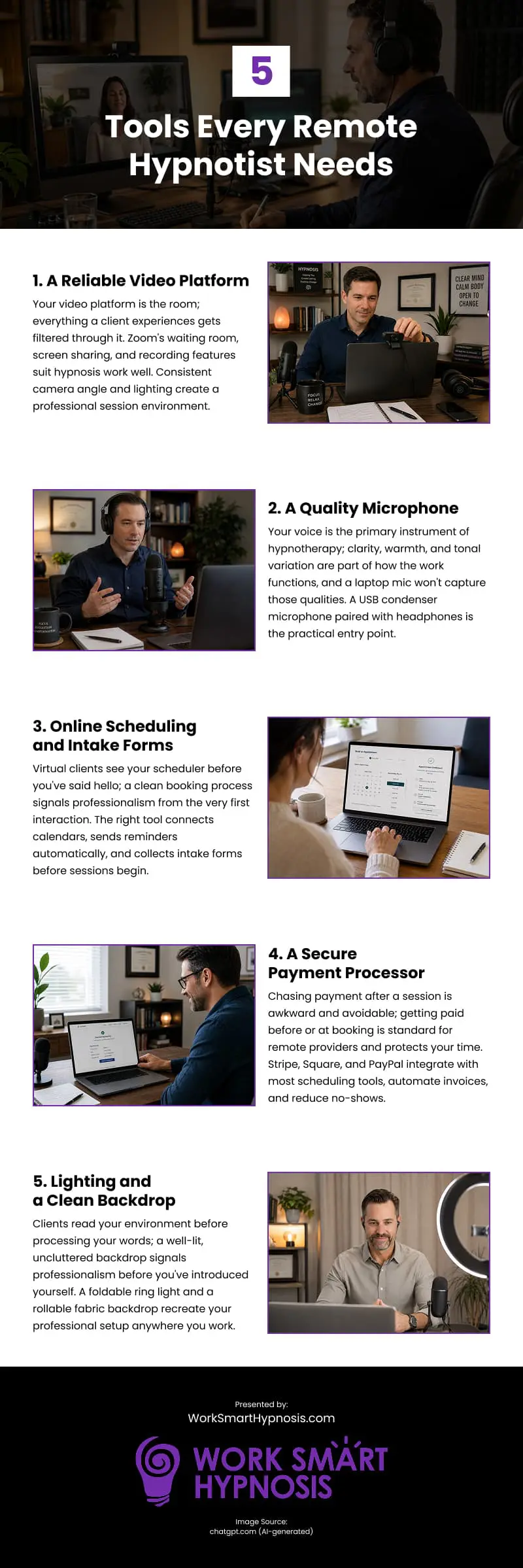
Plenty of hypnotists run fully remote practices out of home offices and co-working spaces. Online sessions offer flexibility and reach a broader client base than a local office ever could. If you’re looking into how to start a hypnosis business, opting for remote work may be the right choice for you. You just need five tools to do it right.
1. A Reliable Video Platform
As a virtual hypnosis practitioner, your video platform is the room. Everything your client experiences about the session gets filtered through it. So it’s important to choose the right one for your needs.
Zoom is an excellent platform for hypnosis session work. It offers:
- A waiting room feature that lets you control when clients enter
- Screen sharing for intake materials
- Recording capability for session reference
- Solid reliability across different internet speeds
Many clients may already have Zoom installed on their devices. If they don’t, Google Meet is another worthwhile alternative.
Whatever platform you use, your setup should stay consistent:
- Keep your camera set at the same angle
- Get lighting in place before starting a session
- Enable the waiting room before a client joins
Some practitioners set a virtual background to keep their session space consistent regardless of where they’re working. A simple, neutral virtual background beats a chaotic real one. If you plan to record sessions, let your clients know before you begin and get their explicit agreement.
By creating a polished, prepared virtual environment, your clients may be more willing to trust the session before you begin your work.
2. A Quality Microphone
This is where many practitioners underinvest. For most professions, a laptop microphone does the job. Hypnosis is different. Your voice is the primary instrument of the work. Clarity, warmth, and subtle variations in tone are part of how hypnotherapy functions, and a built-in laptop mic won’t capture or reproduce those qualities well.
A USB condenser microphone is the most practical entry point, and you don’t need any audio engineering knowledge to set one up. When you’re choosing equipment, consider:
- Does it capture warmth and tone detail, or does it sound thin and tinny?
- Is it a condenser mic or a dynamic mic? Condenser mics tend to pick up vocal nuance, while dynamic mics are better suited for louder environments.
- Can you position it several inches from your mouth, away from any ventilation or background noise sources?
- Will it maintain its quality if you share session recordings with clients as support between sessions?
Good audio shapes the quality of everything your client experiences, so apart from a microphone, you’ll also want to invest in a pair of well-designed headphones. Wearing headphones lets you monitor your audio quality in real time and catch any issues before they affect the session. They also block outside noise, which helps you stay present and focused during the work itself.
3. Online Scheduling and Intake Forms
When a client books a session, it’s their first real interaction with your practice. Virtual clients see your online scheduler before you’ve even said hello. A clean, professional booking process signals that you are a serious hypnosis practitioner. A string of back-and-forth emails about availability signals something else.
Consider scheduling tools that will be most useful for your clients. The right tool connects your calendar directly to your clients’ calendars so they can:
- Book available slots without waiting for you to reply
- Receive automatic confirmations and reminders
- Complete intake forms before the session begins
Make the experience as seamless as possible to make a strong first impression.
4. A Secure Payment Processor
Chasing payment after a session is awkward for everyone. Getting paid before or at the time of booking is standard practice for remote service providers, and it protects your time as much as your clients’.
A few payment processors work well for remote hypnosis work, including Stripe, Square, and PayPal. They integrate with most scheduling tools and let you set up session packages and deposits. They also send automated invoices.
Requiring an advance payment can also reduce no-shows. Most people who’ve paid for a session will show up for it.
Consider offering session packages. If a client books three or five sessions upfront, you’re both committed to a process rather than a single appointment. That continuity can help you produce stronger results and receive better referrals.
5. Lighting and a Clean Backdrop
Clients read your environment before they consciously process your words. A well-lit, uncluttered backdrop signals care and professionalism before you’ve introduced yourself.
A simple ring light, positioned in front of you at roughly eye level, solves most lighting problems. Natural light from a window works too, as long as the window is in front of you, not behind.
Keep your backdrop clean and neutral, whether it’s a plain wall, a bookshelf, or a simple fabric panel.
Consider a setup that travels easily, too. A ring light that folds flat and a fabric backdrop that rolls into a carry bag let you recreate your professional environment anywhere. Hotel rooms, vacation rentals, and borrowed spaces all work just as well as your home office once you have the right gear.
Set It Up Right from the Start
Remote and in-person sessions can both deliver effective work when set up right. As long as you invest in good audio, a clean visual environment, and a smooth booking process, you can run a practice that’s just as impactful as anything happening in a traditional office.
None of these tools requires a large budget or technical expertise, just intention. Get them right, and your work location need not limit your ability to help clients improve their lives.
Infographic