Disclaimer: Transcripts were generated automatically and may contain inaccuracies and errors.
Every story is about change. Either the main character changes or the world changes around the main character, or the main character’s perception of things changes, or the audience’s perception of what’s going on changes. There’s always change, which is funny since we do change work, right There is always change involved in any good story.
Hypnosis helps people take back control of their lives. But here’s the thing. Too many hypnotism to struggle to get consistent results with their clients or grow their hypnosis businesses. I’m Jason Linett, and after more than two decades of building a thriving hypnosis practice, I created this podcast to help.
You do the same.
Whether you’re just starting your hypnosis journey or if you’re ready to scale your business to the next level, you’re exactly where you need to be. Welcome to work smart Hypnosis storytelling is one of the most powerful strategies that hypnotists can make use of to help their clients. It’s where we can do direct suggestion hypnosis and, well, directly suggest to the client, here’s what you’re going to notice, here’s what you’re going to experience. And that is a powerful, proven strategy. We can make use of emotional change, such as methods like hypnotic age regression, perhaps even parts therapy, and anything involving stories from the past.
The benefit though, in my opinion, of storytelling is that it allows you to figuratively create change, but also create these little unconscious associations that now there are mechanisms in place that further compound the change, even after it’s already in motion. And a bit of an unofficial law and rule of all things hypnosis and hypnosis training and yes, indeed, hypnosis podcast is the fact that I just mentioned storytelling. I have to now bring on James Hazlerig. Now, for those of you that don’t know James, you’re about to meet him. He’s been a previous guest on this podcast multiple times. And I wanted to do something here, that is to draw out a conversation that I had with him in a public forum. I hosted an event with a bunch of people back in December 2024, and.
And the material from that event was so phenomenal that I’m actually going in and pulling some of those archives out and sharing them with you now as podcast episodes. I’ll tell you part of the conversation you’re about to hear. It’s that James is somebody who, you know, regularly attended conferences. He and I hosted a training together, I believe, back in either 2017 or 2018, one of those. And then since then kind of stepped away from the community, not for any particularly negative reason, but instead just to kind of go, hey, you know what, here’s what I’m excited about doing, here’s what I’m passionate about, and I’m going to put my head down and focus on that. And that was simply seeing clients. And you’re about to hear in this conversation a bit of an update on his story.
But as well as diving into where we find confidence as practitioners and how the stories of our clients unlocking their own personal change becomes a big part.
Of our ability to further serve our.
Clients moving forward, we’re gonna dive deep. Of course we are. Into transformational storytelling. And let me give a bit of a preview. I absolutely love James’s definition of hypnosis. He refers to it as the art of getting real results from imaginary or suggested events and the ability that story gives us to be, well, to use the word spellbound by a story, it naturally creates a hypnotic state and it creates that opening to then make suggestions and then apply change. There’s several stories that James shares throughout this conversation here, as well as, oh, I just have to be cryptic and just give a bit of a preview. The absolute best pirate themed fiddle rendition you will ever hear of, Thunderstruck by acdc. And if that doesn’t get you to listen to the rest of this episode, I don’t know what will.
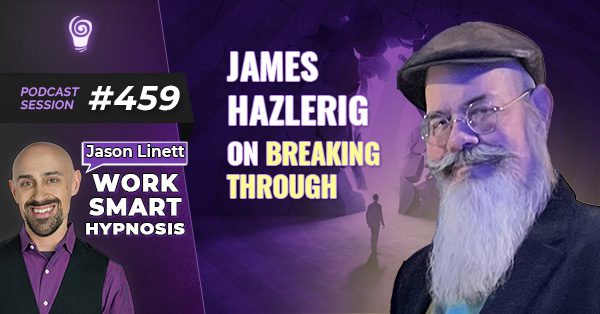
But it’s also the fact that a big theme of this, the longer title of this conversation was breaking the bond that holds you back. We only have so many text characters I can use when releasing a podcast, so that’s where this one became. James Hazlerig on breaking through the final points of this conversation, dive into how do we layer in change? How do we create multiple layers of the shift that has to occur, whether it’s direct or indirect, metaphorical, kinesthetic, emotional, and really using story to, well, trust our intuition, break out of rigid formulas and then by doing so, truly be in the moment with your client and give them the experience that they need. Can you tell how excited I am for you to listen to this conversation?
It’s that good.
That’s why we’re putting this front and center in front of you here today. This week’s episode is number 459. So as we do, you can go over to worksmarthypnosis.com 459 and check out the details, the show notes, the links, the resources we’re going to share along with this week’s episode. And and while you’re there. Also head over to live.worksmarthypnosis.com We’ve always got an upcoming live and online Worksmart Hypnosis live training event. This is an interactive event over the course of several weeks, combining live instruction, live practice, and interaction with a digital library designed to help you to become confident, creative, and flexible in your abilities as a hypnotist. Traditionally, about half of the people who attended this event are brand new and just officially getting trained in the early stages of their career.
Meanwhile, at the same time, we also have the other half who, like many of you, already have been trained or perhaps already out there seeing clients. And yet it’s that confidence, it’s that clarity in terms of how to work with your clients in real time and break out of rigid protocols, put down the scripts and truly engage with your client and in real time and create phenomenal change experiences. That’s what this event is about. So check it out [email protected] and hey, let’s dive on in. This is session number 459, James Hazlerig on breaking through.
So I’m actually sitting here right now with James Hazlerig. It’s like two minutes before were supposed to go live. So I guess this is the unofficial pre show and the unofficial part that people get for diving into the replays. So in terms of what we’re about to dive into, give us a nugget. What should people keep an ear out for?
Wow. I have no idea, honestly, what they should keep an ear out for.
And right there is one of the greatest takeaways of that of really being in the moment, really being present, and going in without any sort of preconceived expectation. That’s what you meant there?
Yeah, sure. Yeah, that sounds good. You know, I, as always, my man, I, I think really, I mean, my main point is that confidence comes from your identity, and identity is a story you tell yourself about.
Let’s do more of that.
So, yeah, here we go.
I’m gonna hit the button.
I’m gonna let everybody on in. All right, and here we go. There’s the avalanche of awesomeness as people begin to pour on in. And just for some context here, I sent an email out just a few moments ago that just simply said, hey, you don’t want to miss this, and no one jump on the whole thing. You just gave a negative suggestion. I, I, okay, thank you, James. No, but so often we get into this sort of deeper, you know, internal story. Where’s my spotlight? There it is. We get into this deeper thing around language and specificity.
And I actually hit record on the process of this before we officially let everybody in, which were chatting for a quick moment, which, if you caught it, who saw it last night, you all got a brilliant welcome message right at 11:40pm saying, we started 15 minutes and Jan, I didn’t see you log in. Then again, I was asleep at the time. Although, let’s look for insight, let’s look for meaning out of it. It’s that, you know, we can catch these moments and things happen along the way, yet it’s really what we do with it. It’s really how we adapt from it. And I’d be about as transparent as I can be without pulling the is it okay if I get vulnerable moment.
And it’s that as I was putting this together, there was a wide open invite in terms of people who I brought on to go, hey, what is it that you’d like to bring to this? What is it that you’d like to bring to this?
And.
And only in one specific scenario, and the rest of this is wide open. Only in one specific scenario was the moment where I went, I want you to at least do this thing somewhere in the process of it. Everything else, it’s entirely up to you. And if there’s any bit of subtlety inside of what we’re about to get into, I’m sitting down for the first time throughout this event. And that should share with you some insight in terms of why I’m so excited to have James Hazlerig diving in with us. So, everybody, big welcome for James Hazlerig.
Hi, everyone. It’s been a while and it’s good to be back and talking to people.
Could I ask. We’ll ask the question later. I’m going to do it right now. Where the hell have you been?
Yeah, I’ve been here. I, I’ve, you know, back during lockdown, I, I quit going out to conventions and things and I did a lot of online stuff then. And after lockdown, I stopped doing as much online stuff because there wasn’t as much online stuff and I didn’ going out to conventions again. But I’ve been, you know, hanging out on my property, taking care of goats, which we acquired during lockdown and, you know, herding chickens and playing music. You know, I have a great time getting to play a lot of music and use my hypnotic language patterns to convince people to tip us outrageously. So. And I’ve been, you know, of course,
My pirate themed cover of ACDC I’ve ever heard.
Thank you, thank you. We’re very proud of that.
It’s a crowded market, I understand, but just pirate themed covers of AC dz, here’s where you go.
Right, that’s. It is really at the top of that particular niche. And you know, I switched my entire practice to online during lockdown and I paid monthly rent on an office for several months and then finally went, I’m not going to go back. And so I just shut it all down. And that transition has been fantastic. I’ve really enjoyed it.
And I do get to reveal one part of this too, that James worked with me for a while in terms of assisting and coaching in my company. And one part of the peaceful exit out of it was that I was having to compete with the fact that he’s Santa Claus.
Yes, there is that. Yeah.
I.
And a lot of people might be shocked to notice a total lack of hair up here, as when I entered the hypnosis community, I had hair down to here. And then in around 2012, I cut it short. And in 2021, I, I shaved it bald for Santa purposes. My, my beard and mustache were finally dark enough I could just put a little white into it and not have to wear a dang wig. And I looked at the hair on my head and said, it’s already thinning. I’m just going to shave it all off. And been very happy with that change.
Trying to resist the years where that’s about to happen with mine as well.
You know, it happens to the best of us. I know so many former rock stars out there now bald, but we have a beard, you know, exactly. Somewhere.
So we get to this theme of confidence. And, you know, one of the things that’s been popping up consistently here is that of either the stories that we’re telling ourselves or the stories that, you know, inspire us to move forward. I want to rewind back for a quick moment because you have a very early origin story involving hypnosis.
Yeah. 57 years ago was my first experience with hypnosis when my mother used it to control the pain of childbirth. And now, of course, I don’t remember that experience. I sometimes jokingly say, oh, it was great. No, I don’t remember that. But what I do remember is that every year, four times a year, because I’m the fourth of four children, my mother would tell the story of one of our births and it always involved hypnosis. So four times a year, I got to hear about how hypnosis is real. It’s not the crazy stuff you see on TV with the pocket watch. It doesn’t, you know, lead to you losing your soul to Satan or anything like that, or going crazy. And it’s effective. It’s powerful.
And so I grew up with that narrative about hypnosis, and I think that’s part of the reason why I was able to make that transition into becoming a hypnotist. I had already been doing hypnotic things for quite a while. I just didn’t know what to call it.
It’s interesting because there’s only been a few times over the years, like, different conversations on the podcast where the dialogue was that, you know, oh, we hear this in training. It’s like, oh, I wish if I’d grown up with this, if this was something that I found much earlier on, you know? And we’ve had some cool moments of, like, here’s Mark Andreas telling the same story. Yet his is the. I grew up hearing it all the time and just. I was used to it at that point. And also brings in the question of, did some of the double bind type things about taking out the trash work? He go, no, we just all knew exactly what we all were doing to each other. There was. Yet at one point, like, this wasn’t the journey.
And really correct me on this, you were getting into hypnosis at one point already as a professional storyteller?
Yeah, I had been. So technically, I’ve never been a professional storyteller, but I was a competitive storyteller for quite a while. And I, at one point, really thinking about it, said, my goal is to make people feel something. And I considered it a great victory if I could get the audience to shiver on a hot summer afternoon in Texas. And when I did that, I said, okay, dang it, I’m good at this. I am achieving what I want to with storytelling. And then when I went and took my first hypnosis training, they said, oh, and by the way, storytelling is 1 4. I’m like, really? Wait, what? And that has really led into me realizing I said, I was never a professional storyteller. That’s not true. I professionally tell stories to my clients all the dang time.
In fact, my model for how I see hypnosis is that my clients come to me with a bad story about their lives, and I help them change it into a better story and then hypnotize them to believe it so much that it becomes true.
There’s a specific definition of yours that I’ve heard you share before in Terms of just how we break down hypnosis and how we just define what this process is. You share that?
Yeah. So I call it the art of getting real results from imaginary events, or sometimes imaginary or suggested events. And, I mean, my standard explanation is always, hey, have you ever cried when watching a movie? And, you know, I like to do that because it normalizes how hypnosis works. Earlier today, Jason was talking about how he explains the process before he does it. And I know there are a lot of hypnotists who like to be very mysterious, and I have never wanted that. I mean, sure, it’s fun when it happens, but I find that even when you explain the process and then do it, people are incredibly impressed anyway. And so you don’t have to appear to be some mystical wizard. They’re going to decide you are anyway, after the fact, anyway.
You know, the fact that when we are listening to a story or when we’re telling ourselves a story, we are living it, we are experiencing it vicariously. And that’s much of the essence of hypnosis. And you’ll notice my definition does not necessarily require trance. Yeah, I’m one of those crazy people who says, oh, maybe trance will happen, maybe it won’t. Doesn’t really matter. Most people go into a trance when they are hearing a story. That’s what we call being spellbound. Spell, of course, is an old word meaning story. For instance, in the Gospels, which are the God spells, the good stories. That’s what it originally means, spellman as an old word meaning storyteller, which really amuses me that there’s some TV producer named Aaron Spellman. When people are spellbound, they’re still.
Their eyes glaze over, their breathing gets kind of deep, and they lose awareness of things around them. So stories are inherently hypnotic. And when we start thinking about confidence, I think that confidence is a thing that arises from our identity, and our identity is a story we tell ourselves.
So then that identity. I’m probably already assuming this in the right direction. I’m just curious to hear your take on it, which would be that here’s something that the identity is really just a marker in time, that here is the representation in that specific moment. Or are we looking at the identity as here’s something that’s constant and takes more effort to begin to shift?
And that’s. I’ve never really thought about it from that angle. I think probably the first, because our brains are always changing and how we view the world is always changing in tiny ways. And I’m sure there are some people who are completely stuck and never change how they see things. But even things we don’t realize are changing change constantly. I go back and listen to a recording of a show that I did 10 years ago and I’m still doing the same show, but I’m like, oh, wow, okay. I word things very differently. I do things very differently now. And it wasn’t ever a big change, but these gradual changes. So with identity, I think we’re constantly revising it and I’m going to tell on myself actually right now.
When I saw theme of this was confidence, and I started thinking about, okay, why do I think about confidence? What are, you know, how does it all relate? I realized that I had been telling myself a bad as in not useful and bad as in false story about my own identity. Because for, you know, 57 years of my 57 years on this earth, I have believed that I lacked confidence and had low self esteem. And I mean, I recognize confidence as a spectrum. And I knew I had come, you know, quite a ways from where I used to be. And then I started thinking about all the things that I’ve done that I hear other people saying, oh my gosh, I was so nervous and scared to do that. I thought, wait, people are nervous about that? Really?
It’s just a thing I did, right? I mean, street hypnosis. I just said, okay, I’m gonna go do street hypnosis. I didn’t know you were supposed to be worried and scared and nervous about it. I didn’t know you were supposed to spend a lot of money getting trained in how to do street hypnosis. I just found a place to go to a street and put up a sign and did it. And there are a bunch of things, I don’t want to brag, but there were a bunch of things in my life that were like that. And I thought, you know, I don’t think I ever really did lack self confidence. I’ve gained more, but I think I was lying to myself that whole time.
This hopefully isn’t too personal of a thing. It’s where, you know, there’s times where going to conferences that we knew each other and it was like, hey, Mid America, I’m going to be going, oh, you’re going want to just share a room? We’re never there now. The last time we did that was my favorite, where you just politely asked, oh, what do I owe you? And I went, cheaper hotel, it’s not that expensive. And I did the math. It’s like this amount of money. You can give it to me or.
I can hold it over your head.
For the next three days. James, I require lunch. It was fun.
Yet from that event, I don’t remember that at all.
You didn’t remember being on the podcast the first time either, so we’ll say that’s true. I earned that. No, but it’s where I can think of. I don’t have the specifics, but a few moments where I noticed a change within you, where someone said something about the work that you were doing or someone referenced something that you were doing, and I saw that shift in you to go, oh, that is what I do. Oh, this is having an impact beyond what I specifically had in mind. So often it might be where it’s, I love your version of it, which is the, oh, I discovered the confidence was there because the things weren’t bothering me, the ways that others were describing it, or sometimes it is the shared experience of someone else recognizing someone else, acknowledging.
And it kind of brings us back to not even a discovery, but it brings us to where we are right.
Now, without a doubt. And I will confess, I mean, confidence is something I do still work on. I was just sort of surprised to discover there were certain areas where I never even felt like I needed extra confidence. I do keep a file in my computer of great things that clients have said, and I periodically will go and read through it just to remind myself of cool stuff that I’ve done or that I helped them do, really, that helps reinforce that identity as someone who’s capable, someone who is successful.
I’d be curious to ask if there’s, like, a specific client story, a specific client win, that kind of comes to.
Mind that illustrates that, oh, my gosh, the list is really long at this point, you know? Yeah, no, I mean, it is. And honestly, and I mean, we joked about, you know, I forgot being on the podcast. I don’t think of myself as forgetful. That’s probably good. But I honestly, when I go back through there, oh, yeah, oh, I remember that client now. Oh, I had forgotten about this. So there’s some really cool ones. One of them that just pops into my head right now, I had a guy who had cyclic vomiting syndrome, right? And I love it when they come to me with something I have to Google and they say, can you help me with this? I’m like, oh, yeah, I’m the specialist in it. I’m sure I’ve done it more than any other hypnotist.
Now, I don’t say that, but I usually Say, I believe that hypnosis can help you out. And so cyclic vomiting syndrome is where every day for a period of weeks to months, the person suffering from it has to vomit. And so he would be like driving home from work as quickly as he could so that he’d get to his bathroom to vomit and then it’ll go away for months. And he said, and there’s some stress that triggers it, but you know, it’s not just stress. And so I said, all right. You know, typically I recommend that we start off with a three session program and then, you know, if we feel like we need more, then we can always do more. We might not even end up having to use all three of the sessions.
But I like to, you know, have that as a starting point. And he said, oh, no, mine’s really bad. I’m going to need six. So he signed up for six sessions. I’m like, okay, I’m not going to argue with you on that. If that’s what you believe you need, then let’s do it. So we did the first session and he came back the next time and said, it’s all gone. I haven’t had it at all. And I’m like, okay, are you at all worried about it coming back? He says, you know, I do have to go meet my future in laws next week. And that has me a little nervous. Oh, okay. So we did work around that. I said, call me when you get back. Let me know how it goes. He called me, he said, man, everything’s fantastic. I think I’m cured.
I don’t. And I’m like, we don’t say the cure word right, But I don’t seem to have this problem anymore. And I said, okay, cool, you know, do you want me to refund you for the other session? He says, nope. And I said, I’ll tell you what, you have them in your back pocket if you ever need them, you know, you can use them. Heck, if your bride to be decides she wants hypnosis, she can come in for one of those sessions. Never heard from him again, except periodically to get a note that said, hey, just got married. It was great. Hey, just to met this milestone. It was great. No problem.
So then in terms of bringing this into the context of storytelling and hypnosis, you know, a lot of things come into this conversation, a lot of different things come into this dialogue. I would ask you just from a bigger picture perspective, you know, what are those elements of story that really need to be, in your opinion, the highlight really need to be the focus so that then the story doesn’t just become a moment that’s, you know, just in our nature of indirect suggestion and everything else we know yet, like, what are some of those elements of story that should be taken note of to then bring into the work?
Sure. Every story is about change. Either the main character changes or the world changes around the main character, or the. The main character’s perception of things changes, or the audience’s perception of what’s going on changes. There is always change, which is funny since we do change work. Right. There is always change involved in any good story. And so in order for it to go beyond just the fact that any story is hypnotic and you can weave indirect suggestions into any story, it’s really ideal if the story has a point that is somehow analogous to something that your client is going through or something that you want your client to. To understand. And you had actually, back when you first contacted me about doing this, a story that I often tell, and I use it in my smoking cessations.
And it’s a really, it’s a poignant story. It’s a true story. Now, I don’t get all the facts exactly right every time, but say to my clients, you know, a lot of people have said that they feel as though they are enslaved by the cigarettes. And especially if the client has mentioned, oh, I hate that cigarettes control me, you know, I hate. And some of them will even say, I feel like I’ve been enslaved. And so I say, now it is an exaggeration to say that smoking is as bad as slavery. Clearly that is disrespectful. But it is something that resonates with a lot of people. And usually my client is nodding at that point. Yep, they understand, they know that feeling.
And so I say, and I’m an amateur student of history, and I find it fascinating to read about what happened when news of the Emancipation Proclamation drifted through the South. And, you know, it took quite a while to get all the way through the south. In fact, June 19, Juneteenth, the big celebration is when it finally got to Texas. That was the last place where they told people. And as it, as the news reached different plantations, different people had very different reactions. Some places, the owner of the plantation quietly announced all of it and then went and locked himself in his room and barricaded himself. Other places, the owner of the plantation threw a big party. Congratulations, you’re all free. Right? At some of them, they said, hey, you know, I’d like to hire all of you. You’re really great workers.
And of course, the people who had been enslaved had different reactions. And some of them heard about it and said, I don’t know how to be free. I can’t even imagine any life other than the life I have here. I guess it’s not that bad. I’ll just stay here and I’ll be an employee and then take the money they pay me to pay my rent, and nothing will change in my life. And those people were essentially enslaved the rest of their lives, I’m sad to say, by their own choice, by their own limitations. Now, there were other people who said, oh, no, I’ve never bought into this thing. I am getting out of here. And they hopped up and they ran right over to the property line, and they stopped and they froze and realized they couldn’t cross it and walked back and lived.
Essentially, just like all of those in that first category. There are those who walked up to that line, froze for a moment, and then forced themselves to step across and had a panic attack and step back onto the property. And some of them turned around and gave up. And others kept stepping over each time wondering, when am I going to hear the dogs and the men chasing me down? And some of them just kept going. Now, some of them crossed the line and never looked back. Some of them had to keep trying many times until they finally reached escape velocity. Mr. Jordan Anderson, I don’t know which category he was in. He definitely wasn’t in the first category, because as soon as he got the news, he turned to his wife, he said, get our two daughters. We are getting out of here.
And I don’t know how many times they had to cross that line before they finally were on their way. And they just kept walking north until they got to Ohio. They found a friendly abolitionist church that took them in. And the people in the church gave him food and clothing and shelter and odd jobs to work to earn money, because they were no strangers to hard work. And so before long, Jordan had built up a little nest egg, bought himself a farm, and he had this great little farm. The first year, he and his family just did subsistence farming, just enough to feed themselves. And the next year, he put in a cash crop. So by the time the war ended, Jordan Anderson was doing pretty well.
And it’s about six months after the war ended that he received a letter from his former master back on the plantation. Now, we don’t know exactly what that letter says because it was not preserved, but we do have Jordan’s reply, because, of course, Jordan couldn’t read or write himself, he had to have somebody read the letter to him and he had to dictate a response. The person who took the dictation thought it was so brilliant that they made a second copy and sent it to the local newspaper. And from there other newspapers picked it up and kept republishing it. And then it was picked up into a collection of great letters of that time period. And even today, you can look it up on the Internet. Jordan with a U J O U R D A N Anderson.
And I’m going to paraphrase what Jordan had to say. He said, thank you, Colonel Anderson, for writing to me. I’m really touched. I wouldn’t think you would give a second thought to poor old Jordan. And I want to thank you for all of the greetings from my dear friends who are still back there on the plantation. Please tell them all that I love them and I miss them. And when you see John, could you thank John for that time when he took the gun away from you when you meant to kill me. It’s at that point in reading the letter that you think this is a very complicated relationship. And he said, and thank you, Colonel Anderson, for offering me a paying job.
Wow, it really must have taken a lot for you to admit that you can’t run your own plantation and that it was poor old Jordan who kept everything working for you. I’m very touched by that offer. It’s very generous. But, you know, I’m doing pretty well on my own up here without a boss to tell me what to do. And honestly, I don’t think I can trust you after you stole my labor for all those years. How on earth could we ever re establish any kind of trust as employer and employee? I know. Why don’t you pay me my back pay for all those years you’ve robbed me? And he sends him an itemized bill and he says, also, you’re going to have to pay hire my wife and pay all of her back pay.
And there is all the time that my daughters spent out there in your fields picking cotton and tobacco when they should have been just being little girls, playing or going to school, learning to read and write the way that they’re learning now. And honestly speaking of my daughters, you are going to have to get down on bended knee and apologize for certain indignities done to the women in my community. Man, you read that letter and you think to yourself, that man is free. He’s not free because Lincoln signed a piece of paper. He’s not free because Somebody won a war. He is free in his heart because that is his identity. He is a free man. And somebody pretty smart once wrote that no one can free a slave. Slaves only free themselves.
So, officially, it’s called smoking cessation, But I like to think of it as smoking emancipation. So let me know when you’re ready to be free. So that. That’s an example of one of the stories I use to help shift people’s identity and help them step into being the best version of themselves. The one that isn’t trapped in cigarette smoking.
Now, two things.
Wow.
Second thing, which script book is that it? No,
It’s on the Internet. You can buy it, actually. So I did a class at Hypnothoughts Live way back, really, before 2020, on storytelling in smoking cessation. Yeah. And I see Jan Ferguson has posted a link to the actual letter. And I know I paraphrased it, and I’m sure there’s a few details that I got wrong, but the message of it is the same.
What’s beautiful of that, it illustrates that often some of what could be the more powerful moments are a matter of stepping outside of just the one industry and just asking the question, what is this? Like, how does this apply over what is another illustration of this. And, you know, it’s part of what I’m going to hit later tonight, that we can address something directly. We could address it indirectly. The way that I’d look at it is it’s not the thought of, how many routines do I have, how many tricks do I have in the toolkit? Yet we can address the issue directly, indirectly, metaphorically. We can address it kinesthetically, emotionally. There’s all these different layers to it. And if we’re looking at how do we build a session structure, it’s bringing in several components and not just the linear.
I did this one thing, and that was it, though. Thank you. I’ve used that process with many people over the years, and at times not just the smoking category, but what is the place where there’s this concern, this fear of what if I backslide? What if I go back to the old way? Like, the way that I see hypnotic change and even just personal transformation is it really cements itself when just the old issue is so completely incongruent. It doesn’t make sense to go back to that old way of thinking.
Yeah.
And, like, we want people thinking more on that level, as opposed to, you said some magic words and you snap the fingers, and now the craving’s Gone. It’s where, you know what? Even if there is the craving, even if there is the moment where just a hint of this public speaking fear creeps in, even if there is the moment of vomiting on schedule, whatever the concern, I missed part of that. Whatever. The thing is, it’s just. That’s no longer part of. I told the story earlier about, you know, the work with theater and with world premieres, and there was a inappropriate anecdote in all of this where occasionally I’d get the email that pops up and you just receive $400 on PayPal. My phone would ring and I’d pick up the phone and go, mike, I don’t do this anymore.
And he goes, I know. You’re doing it now, aren’t you? I’m like, yes, I’m doing the document. How’s it going? Oh, we’re doing on this plate. Oh, that sounds great. I take weeks off at a time. I’m like, we’re jabbing at each other aggressively on the friendship and. But just the. I don’t do that. That doesn’t fit the idea. The idea of, do you miss it? It’s like it’s not even the conversation. I can enjoy that art form in the audience now. I don’t need to be the one behind the scenes or back to what Nathan shared earlier today. What if it doesn’t work? Okay. What happens when it does?
Yeah. And, you know, I was really struck by that. And of course, he, you know, he addressed that fear that so many hypnotists have, because the thing they don’t really tell you is, oh, you’re going to be essentially an entrepreneur, a solopreneur. You’re going to have to start your own business if you want to survive in this. And, you know, over the years, I’ve had a few times where I get a call from somebody who says, I just got out of hypnosis school. Do you have any entry level positions? No, no. No one does. There aren’t any. I mean, you know, yeah, theoretically you can find a few here and there, but you don’t want them. And I had that fear. And interestingly, you know, Nathan’s approach of, okay, instead of asking, what if it all goes wrong?
Asking, what if it all goes right? Certainly you want to do that. But what actually got me through that was a blowout. And I’m, oh, gosh, I am blanking on the hypnotist name who helped me with that now, that’s terrible. But he said, okay, what if it fails? Then I won’t be able to pay my bills. So what’ll happen if you can’t pay your bills? I said, I would probably ask family to help me out paying my bills. He’s like, yeah, so you’d still be able to pay your bills. I’m like, I know, but it’d be so embarrassing, so humiliating. He’s like, yeah, but you would turn things around. I’m like, oh, yeah, okay. I would. He said, okay, what if. No, not. What if nobody could come to your rescue? Then what would happen?
Like, I wouldn’t be able to pay my bills, and I wouldn’t have anywhere to live anymore. I’d be homeless. He says, okay, what would you do when you’re homeless? I’d say, I’d figure out some way to not be homeless anymore. I’d figure out some way to dig my way back. He said, so no matter how poorly this goes, you’re gonna be okay. I went, wow. And that was when I lost my fear of failing in the hypnosis business.
Also with your story. I mean, when all else fails, you could just go back to prison.
That’s true. That. Oh, well, yeah, except they. They didn’t pay me. That was why I stopped.
Probably be explained otherwise. People go, wait, what?
I know. Yeah.
Yeah.
So I spent a while as a volunteer instructor at the Travis County Jail. So my joke was, I go to jail every week, and I had a. I loved doing it, but it was one of these promises of, come in as a volunteer and we’ll figure out a way to get you paid eventually. And after a year and a half of. I’m pretty sure in another month or two, we. I was like, you know, I’m really sorry. I can’t keep doing this for free. Honestly, it broke my heart because I loved doing it. I loved working with those guys. They were fantastic. And, you know, really what we did in that course, we called it mental freedom. And it was about not internalizing incarceration. It was about not taking on the identity of a. A convict, a career criminal.
And I remember somebody asked me one time in a hypnosis forum, how do you build rapport with criminals? And I said, there are no criminals in my class. There are fine gentlemen who have the temporary, unfortunate condition of being incarcerated, But I know they’re going to go on to do great things in life. And I would actually begin the class by telling a story, something I. I heard on NPR about a man who had been in solitary confinement for many years. And when he finally got out, I’m Thinking, wow, you know, if that happened to me, I would go hog wild. I’m like, I’m going to Disneyland. I would want to see everything. I’d have a bucket list. My gosh. No. He moved in with his sister.
She had a spare bedroom which had an adjoining bathroom, and she brought him his meals and he stayed in that one room the rest of his life because he was in jail up here. And so I said, my goal is to teach you the opposite. My goal is for you to be free even while you’re in here. And so I would work with him on that. And one of the most amazing experiences were. One of the protocols was, by the way, you never tell them your last name. I was Mr. H. You never tell them where you live. You never give them any way to track you down once they’re out. I was at the grocery store one day and this young man, and I didn’t recognize him because, I mean, I. There were so many, right.
Comes over to me and he says, hey, Mr. H. I’m like, yeah. He says, I’m out here. I’m free. Thank you. And that was. I mean, that was one of the most gratifying things that could possibly happen.
I look at that experience too, and it’s something that, okay, wasn’t necessarily paying right away. And this kind of leads into. Oftentimes it’s that willingness to do something because something is going to come out of it and it’s not necessarily going to be the immediate payout. I mean, my silly and slightly name dropping version of the story is the time where Igor Lenohoski calls me and goes, jason, your podcast is for free on the Internet. People have just uploaded it and you just download it for free. Do you know that? I’m like, yeah, I put it there, but it’s where it was. This story at the beginning for me as to. These are the people I want to have conversations with, whether they remember being on there or not. As completely as I’m not, I’m okay with it.
No, but it’s the willingness to do something and, you know, it’s. We’re on the business side of things. I see so often that someone does something once may not have been done to the best of the abilities or had the right intention. We got incredible feedback from last night just going, hey, here’s the headline structure. It just. Here’s where I start. It just gets us in motion. Yet it’s where it didn’t work that one time. And then that becomes the reason why they go that doesn’t work the same as a technique. They have the moment where. And the way this shows up in a hypnotic process is that, hey, this thing happened that one time. Let me add this extra bit of language for that moment. So that then that prevents that, oh, here’s another moment where it happened. Let me add that in.
And then eventually it becomes all this extra preventative maintenance style work which is then beginning to undo itself. So just I don’t really have a question or a statement around that, just to kind of amplify that. Here’s where I’d ask you, like from that experience where there wasn’t a direct monetary outcome. And yes, we’ve got the end of one of the stories in an incredible way in the grocery store. Like, what were the skill sets? What were the insights that came from that really informed even the rest of the work that you do?
Oh, gosh. Wow. That is a really good question. You know, I mean, it allowed me to really refine a lot of the things that I did. And it actually. So there’s a. There’s actually a story I occasionally tell. Some of us have heard of the drug of choice technique in NLP where you go into a sensory memory of having used a particular drug. Right. You know, Richard Bandler back in the 70s, you know, invented that. And Richard Bandler and Grinder, those were their names. And, you know, came up with this way to get high without taking any drugs. The guys in my program actually were all people with drug related offenses. And one of the things I would do in the very first meeting was the lemon visualization.
And it’s a standard, I do it with nearly every client, where you go through the sight, the sound, the sensation, the aromas and the flavors of experiencing a lemon. And then most people end up salivating from it. And I use that to explain my whole principle of, you know, you’re getting a real result from an imaginary event. So I did that with this class and one of the guys raised his hand, he said, I already do that, but I don’t use a lemon. And I said, what do you use? And he says, heroin. I went, wait, what? And he said, yeah, is that wrong? I get high in my cell by imagining that I’m using heroin and it works. Is that wrong?
And I said, there were some people who made a whole bunch of money inventing that technique and they were experts in this field. And you came up with it on your own. It’s freaking genius. Now, I don’t typically use that as part of My drug interventions for people. But I have occasionally. I have used it for people occasionally. And just having that story has been an interesting extra thing. I also, I learned a lot about crowd management and setting expectations that have. Has been useful to me in other situations. I learned I would go into the room beforehand, and if there was one chair that was different from all the others because it had padding, usually I would pull up next to my desk and say, this is my chair.
If there was a second chair that stood out, I would get it out of the room because they would fight over it, because they lived in a world where this much padding was as much as they ever got. And that was on their bed. And I’m like, nope, that chair is not going to be in here. I also learned with them, and I learned from working in drug and alcohol facilities that I couldn’t force people to pay attention. So when I would go into the drug and alcohol facilities, I would make sure I set up the space how I wanted it. And they had me in a gymnasium at one point, which was terrible, right? Because there’s way more space than there are people. And so I would set up all the chairs right around where I was going to stand in a semicircle.
And I would make sure that any chairs that weren’t in there were stacked and against the wall. And every time the guys in the drug recovery thing would come in, someone would grab a chair and drag it all the way to the far wall and sit down. I learned, don’t say a word to him. Don’t address it. I would then explain the anger meter, the rage gauge, as we called it. The scale from 0 to 10 is so angry that you’ve caused some kind of harm. And I’d say, okay, who hit a 10 this week? Who hit a 9? Let’s explore how high did we get? And inevitably, that guy way in the back would say, hey, wait, I have something to say. I’d say, okay, great. Why don’t you pull your chair closer so that we can all hear you?
So just the learning about crowd management and getting to practice that.
That and I think of a time someone that you and I both knew before he passed away, Michael Elner, where I reached out to Michael at one point going, I had this person came in that in the middle of the session. And not the definitions. Other would go in terms of, oh, ab reaction. Oh, it’s this. Oh, it’s that. Just in the middle of the session. He’s there and just like, he’s doing that And I think, oh, what do you do with that? And so I call up Michael and he goes, you let him. And you see if there’s a way to utilize it. I’m like, oh, yeah, be in the moment and actually utilize. Thank you.
Yes. And so, you know, while I didn’t get paid for that, and I barely got paid to do the drug and alcohol recovery centers, I did eventually get a paycheck out of that. But even that. Anyway, learning that those things about crowd management are important because I just. Over October and November, I did an eight week stint performing at the Texas Renaissance Festival. And that’s where we did, as you said, that the pirate themed AC DC cover. So before our big show, when we’ve got, you know, anywhere from 500 to a thousand people gathered around, I put on my microphone before the show and go out and get the crowd warmed up. And the last weekend I started saying it. Oh, and we collect tips before the show.
We explain, hey, you know, I’d hate for you to get home and realize you forgot to tip the band because you were so excited at the end. And this last time I started saying, by the way, I’m having a psychotic flash. Oh, wait, no, a psychic flash. Someone in this audience has a hundred dollar bill in their wallet or their purse. And I know you’ve been saving it for a special occasion. And I don’t want to say that tonight is going to be that special occasion. I don’t want you to take my word for it. So I do not want you to reach into your wallet right now, pull out that hundred dollar bill and walk over here and hand it to me right now. No, I want you to enjoy this show. I want you to sing along with us.
I want you to laugh. I want you to cry. I want you to dance. I want you to become part of something bigger than yourself. So that at the end of this show in an hour and 20 minutes, you say, this is that special occasion I’ve been saving it for, and then take it out of your wallet and bring it over to one of the other members of the band that’s more reliable than I am, more trustworthy. Two out of three nights. It worked. $100 tip. And all of my bandmates were just going, holy smokes, you’ve heard me share this before.
Of there’s a lot of inappropriate things in this quick story. I don’t want to be mindful of your schedule here tonight too, though. I’ll share this briefly here. It was that psychiatrist calls up and he goes, I’ve got someone who is obsessive compulsive and he smokes three packs of cigarettes a day. Do you think you could help him? And my gut reaction was immediately to go, I don’t know. Does he actually want to change? He doesn’t want to quit. Okay, what does he want? And the response was, he doesn’t want to quit. But in his words, even I can acknowledge that 60 cigarettes a day is way too many. I go, there’s the foot in the door. And if anything, not to overgeneralize it, his existence is a collection of rules and principles that he has to follow.
We just need to introduce the better one that serves him. And psychiatrist goes, you’re going to use his ailment against him. Can I watch? And I go, okay. And so we did the session actually at his office. And this is where again, I don’t want to quit. I want to go down to three cigarettes a day. And he wrote the process for me, as in one in the morning after coffee before I take the shower and brush my teeth, one after work, and then one in the evening before brush my teeth, everything else. So, like, he gave me the pattern that he wanted there. And we worked together and met up again about two weeks later. How’s it going? This is amazing. I’m having one in the morning after coffee, I’m having one in the afternoon.
It’s like, yeah, the thing you told me you wanted, that’s exactly what we did. Now this is where I may have crossed the line, but it perfectly illustrates to the story of the extra 200 in tips, which was, you know what, though? You know, I just kind of listened to you and I just fed back exactly what you wanted. It was about maybe four months ago that I’m about to start a session with a guy and he goes, yeah, but you’re just. And this was for weight loss. You’re just going to persuade me today. I’m like, yeah, I held up all of my notes. I’m like, yeah, all the stuff that you’ve told me you want, I’m going to say it back to you.
I’m going to say the exact same things back to you, just in a special way so that this time it actually sticks. And he goes, that makes more sense than anything I’ve ever done before in my life. I go, I know, right? You should teach this stuff. So I tell him about that. And here’s the thing, like, you know, you would have done that on your own without me. Now I’m not the one who’s going to try to tell you that in about three or four weeks you’re just going to get bored with those three cigarettes and just decide to quit on your own. And even when that happens, that wasn’t me either. That was 100% you. But it’s entirely up to you. I’m happy that you made this happen.
Normally we would do a session today, but like, just, can I just give you a high five and we call it there? Cool. You don’t owe me for today. I left. A month goes by, the phone call comes in verbatim. You know what? I just kind of got bored with those three a day and just decided that I wanted to quit on my own. But I did that myself. That wasn’t you. I just figured I’d let you know that I’m happier without them. I’m like, good for you. And I’ve repeated that at times and events such as this, it’s like, oh, how do you feel about that? I go, that clearly was part of the intent. Yet at the same time it was okay showing off for the doctor.
But at the same time too, it was that of here was that story that needed to remain, to be there. And just like the moment from earlier of writing the letter and the absolute, no, I’m not going back to that old way of thinking. Before we wrap this up, I would just ask an open ended question that if you had to give a piece of advice in terms of bringing more powerful moments out of stories into the sessions. Actually, before that question the side one first. Oh, the arguments over this one. Do we explain the story to the client or do we let it sit and let them unravel it themselves?
That depends on what my intuition tells me. The official answer is yes, maybe no. Yeah, you know, and that really. And that’s something that I haven’t touched on very much in this, but I would say trust your intuition. We were talking about how you have this massive collection of approaches that you can use and a lot of people want to figure out mathematically, logically, which approach do I use, what’s the order and all that. It’s too complicated for your conscious mind to do it. Trust your unconscious mind. Right. Isn’t that what we specialize in? Trust your intuition and follow your intuition. I have done things where I had no idea why I was doing them and the client later on said that was the most amazing part of it.
Or you’ve hung out with us, which were in scenarios where you had to. Where I go, hey, everybody, we taught a class together a few years ago. When we’re back from the break, James is going to teach Anchored Storytelling. And he looked at me and went, what’s that? I go, I don’t know. It just sounds like a great title. The next 10 minutes. And you came up with something. And it was brilliant, though. Aside from Anchored storytelling, which is of course one of your classics in terms of leaning into the more hypnotic quality, the more transformative part of a story. If I had to give just like one insight in terms of just. It might even just be a piece of awareness of where to have that focus as we’re utilizing story in the process, what would that recommendation be?
So I don’t know if this is exactly answering what you. You ask, but I find that for me, I visualize the story and describe what I’m seeing. A lot of people get really scared and nervous about what do I say? What? And I just, I visualize the story. I’m in there with it with the client and describe what I’m seeing, and that makes it very vivid for them.
You go first.
Yeah, yeah, exactly.
This has been phenomenal. Great to see you back here once again. And for those who want to check out more of what you’re up to, where could they find you?
I mean, I’ve got hypnosisaustin.com but actually, I don’t. I’m not really selling products to other hypnotists. I’m making my money seeing clients and playing music. So, you know, you check out Pride of Bedlam on YouTube and watch the video where we’re playing a, you know, an AC DC pirate themed cover.
Hey, James. Phenomenal. Thanks for hopping on with us and.
Thank you for inviting me.
Just because you’re good at something, it doesn’t mean that you have to do it for the rest of your life.
Hey there.
It’s Jason. And in this afterthought, in these closing moments here together, it’s just you. It’s just me. Let’s have a quick little chat here as we wrap this up. There’s two points that I want to amplify as a result of listening to this conversation once again with me and James Hazlerig. The first one is that statement that I just made. Just because you’re good at something, it doesn’t mean you have to do it for the rest of your life. And it’s neither a good thing or a bad thing to even say that. You know, it’s where you heard James talk about how, you know, he put his focus on the things that he was passionate about.
And that’s why he’s someone who kind of stepped away from the online communities and stopped attending as many conferences and focused on primarily on doing the things he was passionate about. Serving his clients, performing his music, being Santa Claus. And at one point, it’s part of my journey too. I had to be the person who stepped away from theater career where I was working in production management, because my passion shifted over to hypnosis and hanging out with all of you. At one point, I had to be the person whose story shifted from being the guy who did 150 to 200 high school stage hypnosis programs a year to instead be the person who was focused on his clients, his communities. And as a result of that, got to stay home and be more with my kids than be on the road doing those programs.
And I’ll keep this politely cryptic and private here because quite a number of you have reached out over the years to directly tell me that hearing me say, just because you’re good at something, it doesn’t mean you have to do.
It for the rest of your life.
That that quote of mine was a turning point for you. So let that just kind of marinate for a bit there. The second part that I wanted to amplify here is also the fact that right now I’m sitting here recording this outro. It’s March, it’s 2026. So it’s like 14 or so months after this recorded conversation with James. And this is something that I know a lot of you need to hear in terms of your businesses. You should never assume that everybody has heard everything you’ve ever done or seen everything you’ve ever done. So this was a recording that came from an event that I did that we had a couple of hundred people register for, though. Let me throw myself under the bus here.
As much as that event was promoted and people signed up and paid for it, there were people who didn’t attend live and there were people who signed up for it knowing that they would get the replays. And perhaps somewhere in their brain because I told them they would get the replays, it created this little bit of a comfort net and it turned into the story of, oh, one of these days. Eventually I’ll check that out. So look at what I just did, everybody. I just went into my archives and I found something that still is of value and I positioned it with updated framing to then put it in front of all of you.
And I share this because this has been a turning point for so many people’s businesses, mine included, which is again, that phrase Never assume everybody has already seen or heard everything you’ve got to do. The number of times that even I share my all Positive pre talk, which was episode number one of this podcast all the way back to June 2014, and people go, oh, is that new? That’s great. And the times where the stuff that I say that I’ve heard myself say thousands of times for someone new out there, it’s going to be their first time hearing it. And because of that, how dare I keep that message to myself? So you’ve heard your snappy answers to the common questions. Many times you’ve heard your explanations of hypnosis and why it works for.
This and why it works for that.
Yet for the person on the other side, something magical happens when you let your message no longer be about you and instead be about what it means to them. So one more time, never assume everybody has already seen everything you’ve done. Make it easy for them to find the solution that they’re looking for. Thank you for listening to the Work Smart Hypnosis Podcast with Jason Linett. The more we’re all successful, the more we’re all successful. I’ve made that statement for years. It’s why I do this show. And here is one thing that you can do today to help do your part. Go to worksmarthypnosis.com podcast. Go there and make sure you’re subscribed on your favorite podcast platform. And if you’ve enjoyed this episode, I’d love it if you’d leave a review. Your feedback helps other hypnosis professionals find the show.
Subscribe and share your thoughts [email protected] podcast.