Disclaimer: Transcripts were generated automatically and may contain inaccuracies and errors.
And when both therapist or the hypnotist or the coach who’s using hypnosis and the client have high levels of confidence, then the research is real clear. The outcomes are more favorable, more likely to be what is consistent with expectations. And that results ultimately into five star reviews on Google and referrals to our office for those who are working with clients. And that’s how you build a business.
Hypnosis helps people take back control of their lives. But here’s the thing. Too many hypnotists struggle to get consistent results with their clients or grow their hypnosis businesses. I’m Jason Linett, and after more than two decades of building a thriving hypnosis practice, I created this podcast to help you do the same. Whether you’re just starting your hypnosis journey or if you’re ready to scale your business to the next level, you. You’re exactly where you need to be. Welcome to Work Smart Hypnosis. The one thing that’s gonna make you massively successful as a hypnotist and help you to get your message out there to truly help your clients is to finally step into your confidence as a practitioner.
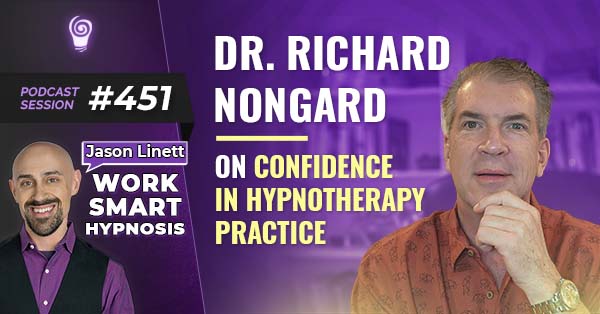
And the one thing that it turns out is probably gonna hold back a few of you is the fact that, well, the confidence, it might not necessarily be there, at least not yet. And if only. Oh, man, if only there was a formula to activate that confidence and either find it or discover it or, well, create it on purpose. Well, good news, that’s actually the entire topic of this week’s episode on the podcast, which this is session number 451. And Richard Nonguard, one of the most common guests on this program, is back once again. And I have this written down in front of me, of course, what I wish the episode should have been called, which is that it could have been called Dr. Dr. Richard Nonguard on confidence in hypnotherapy practice. Because.
And you’re going to hear this at the top of the conversation. Oh, he didn’t just go off and get one doctorate. No, no. He just recently went off and got his second. Now, the topic of it, though, is the focus of this episode, this conversation around confidence in hypnotherapy practice. And I’ll tell you this ahead of time, Richard is one of those people that speaks in refere and has the data to back up everything that he says. And, oh, man, we’re going to go off on a little bit of a hunt now to put all of the references and resources available for you over at the Show Notes page for this episode, which we always make it easy for you. Every episode of the show, whatever number it is, that’s where you go. So this is session number 451.
So worksmarthypnosis.com 451 that’ll bring you over to the Show Notes, and we’re going to do our best. There’s quite a number of them, though. The backstory before we dive in is that he did his study with a number of real working practitioners. And based upon research, based upon data, based upon some experiments, how is it that confidence either develops on its own or how is it that we either then create it over time with the right intention and listen carefully because there is a very clear formula to it. Now, before we dive into this episode, though, I want to point out some of my.
My personal takeaways, which is we do kind of find ourselves occasionally in a bit of a Wild west scenario, especially with different forums and communities and Facebook groups that are out there involving hypnosis, which I have one where people are generally nice, you know, group.worksmarthypnosis.com go there. We have a great community. People are nice to each other there, but there’s a few others where there’s often this sort of jabbing. And the place where it seems someone can’t answer a question in those other communities without going, oh, well, that just means your training sucks.
Well, here’s the thing that I’ve realized, and we talk about this during this conversation here, it’s that the people that I saw as being the most effective, and I’m going to say it, also successful in helping their clients, but also successful in running their businesses were the people who had this ongoing passion for education. They weren’t the ones to go, oh, I already know that. I don’t need that. Instead, they were the ones to go, here’s what I know how to do. Let me see. And here’s my paraphrase of it. Let me see if there’s ways that I can become more flexible or just have more options and better strategies along the journey of this.
So we’re going to point towards specific concepts of past experiences, concepts of modeling others and continuing education, getting direct feedback along our journey, embracing the moments where things don’t go as planned. And it’s not necessarily what happened, it’s more what you did as a result of it and how you felt as a result of it. Oh, wait, did I just fully point out the spotlight that needs to be shined? If you’re Ever doing anything. Hypnotic change work involving the past. Yeah. It’s not necessarily the events, it’s what you make of it and what the perceptions you hold on to.
Now, the part that I leaned into very heavily and let me use the professional terminology here, the part of this conversation that I nerded out like crazy on was the part that Richard spoke of in terms of awareness of emotional status, which does speak to the ownership of our successes and our failures. But one specific word stands out and it’s the one element of our change work that I have found to be the consistent through line with some of the most effective and successful people that I’ve ever met. And I could tell you what that one little three letter word is. But you know what?
Listen to this conversation because there’s some incredible takeaways and incredible insights towards the methods that we use as practitioners as well as how it is that we become more effective over time, helping our clients and just growing as human beings. There’s a quick little dialogue we also get into here, which is that Richard and I have the next ICBCH International Certification Board of Coaches and Hypnotist. We have the next Train the Trainer event happening very soon. And I’ve given you a link to make this easier to find.
It’s also in the show notes for this week’s episode, but worksmarthypnosis.com trainer go there, check out the agenda of things and you’re going to hear us also break down some of the core nuances of this program about how it’s really one of helping you to create your own program and really step into your own authority. All the details of that are [email protected] trainer and let’s use the actual title and not the really long one that I wanted to use. But here we go. This is session number 451. Dr. Richard Nonguard on confidence in hypnotherapy practice. So I’m looking at the records here. You might actually be someone who’s been on this podcast more than anybody else. Though I think the appropriate way to introduce you now is welcome back to the podcast, Dr. Dr. Richard Nonguard. Right?
Yes. Yes, yes.
Yeah. And for those that don’t know the update to this, can you walk through and share the story of that?
Well, the story’s pretty short. I’ve always said I like to read and I like to write, so I may as well get a diploma for it. So I have as many degrees as a rectal thermometer. So back when I finished My master’s in counseling psychology. I thought I should get my Doctor of Psychology degree, but I couldn’t imagine paying more money to learn more of the same stuff. So I didn’t go on and get my doctorate in leadership and cross cultural engagement. I thought that was a better match for the work that I was doing. But I always had in the back of my mind, I wish I had done the Doctor of psychology. So some several years back I went back and finished a Doctor of Psychology degree program.
And that turned out to be a great move because a lot has happened in the 35 years since I got my master’s degree in counseling psychology. So it was great to have that gap. So, yes, I guess Technically it’s Dr. Dr. Richard Nonguard.
So you said a lot has happened. Like what was you kind of put into that very simple statement that I’m sure there’s a lot to.
Yeah, there’s a lot to it. But we now understand the biological basis for mental illness. We understand the taxonomy in different ways that extends not just to mental illness, but everything ranging from behaviors, habits, motivations, drives that people have. And because psychology finally is recognizing the value of the somatic experiences, and this is something, of course, that is a foundation of hypnosis. Whether it’s progressive muscle relaxation or whether it’s mindfulness based approaches to hypnosis, we recognize that we can’t separate mind and body, that they are not a duality. But mind is in every cell of the body and sometimes the body can express things that words, cognitions just can’t.
The way you phrased that was interesting. And I’m going to try to resist phrasing this in a specific way, to not let it sound like, hey, do that thing that you do that I really like, but go ahead and do the thing which is there’s many hypnotists who would put down the technique of progressive muscle relaxation. And you speak to this in of the advances of research and psychology. So, Richard, do that thing you do where you talk about progressive muscle relaxation.
I love progressive muscle relaxation and it’s mocked by pontificators on hypnosis forums as relaxotherapy. But the reality is there’s a huge body of research that shows that relaxation in and of itself creates change. So if I were to simply do a progressive muscle relaxation hypnosis induction and make three direct suggestions, 99% of my clients would say, oh my gosh, Richard, this was an amazing hypnosis session. Thank you very much. We’re always looking for the way to impress Other hypnotists at a hypnosis convention. The reality is our clients don’t care. They want a solution. And there’s a huge body of research that shows therapeutic relaxation is a pathway to resource states. Trans. It is a pathway to physical changes. Think medical clients who might come to see you for hypnosis, for emotional transformation. Think anxiety related problems that people come with.
And I love incorporating methods of progressive muscle relaxation and other relaxation methods in my hypnosis. Someone once said, but that’s a boring induction. Well, Milton Erickson told us that boredom was one of the pathways into a resource trance.
So and it I flashback to a sentence of Stephanie Conkles that somewhere in her profound training that she does it was the statement as to oh, and at this point normally I would do a Dr. Flowers induction because it just works. And I love that little sentence there just to go, yeah, because it just works. And especially what you just said there on the somatic side of it that, well, let’s make it very simple here. Our clients are coming in with something that is stressing them out, that is causing some sort of stress response. Otherwise they wouldn’t be labeling it as some sort of potential problem. And what is that feeling psychologically as well as physically? That is the opposite of that. Well, relaxation makes sense.
And then the hot topic in the world of psychology now is somatic therapy, Bander Kolk’s 2014 book, the Body Keeps the Score, et cetera. But you know, the reality is hypnotists have been using somatic based therapies since the beginning of our profession. We go back to the 1800s, we go back to the Nancy School and we can look at magnetic passes even, and these forms of somatic work, whether it’s progressive muscle relaxation or reiki, like maybe theory behind why it works back then wasn’t the right theory, but the outcome for clients is incredibly positive. And that’s what I like most about being a hypnotist is that all of this stuff isn’t really new to us, but what’s new to us is we now understand the mechanisms that make those things effective.
Well, I mean you said that a lot has changed in 35 years. So it’s where certain topics, certain themes, this is no longer that term, this is no longer this category. And it’s that narrative in terms of working with the best models that we currently have. And those models continue to change as research changes, as understanding changes. I knew that were going to do this, by the way, which is that we decided to hop on and record for a very specific topic. And here we are talking about something entirely different. But then again, as people get in touch not just with their own bodies, but also with how their clients go through the experience of hypnosis and physically respond to it, that builds up confidence.
Absolutely.
For the practitioner and the client. See how I just found the way back on topic here?
Perfect.
Yeah.
The heart of a good hypnosis session is confidence. What you pointed out, both the practitioner’s confidence, my ability to go in with a client knowing that I have something to offer them of value, and the client’s confidence that I made the right choice to see a hypnotist because they’re going to be able to provide me something that others can’t. When both therapist or the hypnotist or the coach who’s using hypnosis and the client have high levels of confidence, then the research is real clear. The outcome’s more favorable, more likely to be what is consistent with expectations. And that results ultimately into five star reviews on Google and referrals to our office or our zoom office for those who are working with clients. And that’s how you build a business.
So then if we go into this topic of confidence, which let me badly paraphrase why I invited you on, and then we’re going to break it down here, which is that. Correct me on this. You basically did that final study to get the doctorate on the role of confidence. But also how do we create the confidence or also how do we find the confidence in our work?
Yeah. My dissertation was titled Confidence in Hypnotherapy Practice An Interpretive Phenomenological Analysis. That’s the title, really. It’s a study in the confidence of hypnosis practitioners. Confidence. What creates the confidence? How do they use their previous experiences to develop more confidence? What’s their perception of client session experiences when they have levels, higher levels of confidence. And if somebody listening wants to go down the rabbit hole, type in Albert Bandura. B A N D U R A Bandura Bobo study. B O B O. That has nothing to do with what we’re talking about today. But he did studies in violence among children. And the Bobo Doll study is a fascinating study. But what he’s also known for is his work in self efficacy. How is self efficacy developed? And self efficacy is a form of confidence. Just to keep things simple here that involves self mastery.
As a practitioner, I know I can do this. I have belief in myself. And it comes from a number of different sources. One of those is role Models. Have I observed other people do hypnosis sessions? Have I listened to other hypnosis recordings? Do I have a mentor or a teacher who taught me? By demonstrating hypnosis, these are vicarious experiences and we observe others being successful. It can increase our belief in ourself. And then of course there’s verbal and social persuasion. This is an element of Ben Dura’s idea, essentially a pep talk. We need somebody who’s in our corner and a good trainer is somebody who, like a good coach in sports or a good teacher in grade school or high school, tells us we can do it even when we don’t feel like we can.
And, and then of course, our bodies speak to us. These are the somatic or the emotional states that we have as we develop confidence. And this is again a contribution of nlp. Confidence has a physiological feeling, a state associated with it. And when we can bring ourselves to that state by setting our own anchors and our setting our own cues to step into that role, we can become more confident practitioners. But the cool thing is that confidence is infectious.
I want to go back to the thing you said before though, which was that having the model, having the trainer, and here’s kind of my interpretation of that, and you might either go, well, kind of, or you might just go, well, actually, no, the research says this, which we’ll see where it goes, which is that there’s something to be said about how when someone does something and we see that it’s possible when we see that it’s within reach. I mean, I go back to the classic story that everyone quotes in this topic, which is Roger Bannister in the four Minute Mile, that here was this period of time where people firmly believed that someone couldn’t run a mile in under four minutes. And then this guy, Roger Bannister, well, he did it.
And then as soon as that happened, though, like within the next year, there were then high school students who then did it too, because the public held belief that this thing was not possible, that clearly didn’t work anymore, and whatever had to occur and shift within the mind and body then became the thing that made that happen. There’s a person I heard speak one time about how in terms of online marketing and online sales, witnessing the person who theoretically was the first one who had the million dollar day, and that suddenly it was this revelation to go, oh, that’s possible. So what I appreciate from this is that, you know, it’s not just the. And clearly I’m assuming the doctorate was not just in, quote, fake. It Till you make it. Here you go. But instead, what are the practical steps?
So rather than being this intangible thing that we don’t quite know how to grab onto, or we can stand metaphorically really far away and go, I don’t know how I can get that. I don’t have that yet. Instead, here are some practical steps. So let me ask you the question, not just from the research perspective here, but the Richard Nonguard personal strategy. What are your specific values, your specific deciding factors to figure out who it is that you model and you listen to when you want to learn something new?
Sure. I like to model as many people as I can. I’ve been to a lot of different hypnosis trainings and I’ve never been to one yet that doesn’t have something that is of value to me. I’ve been to some boring classes. I’ve been to some classes where maybe the teacher didn’t have as much knowledge as I thought they did. But even in those classes, there’s been something that I’ve recognized as valuable. So I think the first step is to, to recognize the value of training and ongoing training. This is why I like, you know, sort of a privilege I have. I can pretty much show up at anybody’s training anywhere in the world without having to pay. Just tell them I’m coming and I can go. It’s a luxury others don’t have. But hypnothants is a great experience for people.
Willie Mitchell’s upcoming conference and in St. Louis every year, Hypnosis World in Chicago, an opportunity to acquire training and ongoing training. We just finished the ICBCH Winter Hypno Conference, had 60 different speakers from around the world. So we have to have training. Right. The next step, though, is to translate when we hear something good or we read a good book, that’s a form of training to gain an experience in it. And the easiest way to gain an experience for some, especially if some aren’t seeing clients yet, is to practice that in self hypnosis. That’s the first experience we can create from the training we’ve had. And then it will become our own experience. That’s just something we learned about. And the next step in that is to again find additional resources to support that.
And a great way to do that is to say, well, gosh, I think this is possible. I’ve experienced this. Go over to scholar.google.com, type into scholar.google.com does this actually work? Right? Is there research on it and believe it or not there’s a zillion people out there researching everything about hypnosis. And you’ll discover then that. That there are other approaches and things that can branch off those experiences we’ve had. This all develops that self efficacy that Bandura was talking about. And then. Wait, Jason, what about. Wait? There’s more. There’s three things that happen after we develop that self efficacy. We expand our practice, we begin to see new types of clients because of that confidence. That creates a higher level of confidence. And then what we do is we integrate that into other forms of work, into more coaching or mentoring or consulting.
We actually can build businesses. And that results finally in continuous levels of being in the groove or being in the flow. I did a session last night which was for the ICBCH certification. It was week number one. And some people afterwards said, oh, my gosh, this session was just wonderful. Richard. Well, I could do that in my sleep. Why? Because I’ve gone through these seven processes, these seven steps multiple times over multiple years. And here’s the cool thing about confidence. You’re always moving towards more of it. My research actually showed. I don’t think it’s surprising, but one element of the research, that when we do a lousy session, when we screw up, when we make a mistake, when we handle a situation poorly, it can actually increase our confidence. Because like NLP teaches us, there is no such thing as failure, only feedback.
Sometimes the discovery of what not to do is just as important as the discovery of what to actually do.
I did a show with Michael du Chalet last week, a magic show. And the audience was small and the audience was difficult. There were four older women in the front row who decided they wanted to speak throughout the show and interrupt the person on stage, which was Michael de Chalet and me. And it was just going downhill from the very opening of the show till the end. And I was really grateful that I had the chance to be a part of that show, because I. You learn more from a difficult audience than you do from a great audience.
It does tend to make a better story after the fact, too.
Yeah, it does.
Yeah. We were in a conversation with a group of students the other day, and it’s someone who, and I’m going to generalize it for obvious purposes, is early in her career, is now seeing clients for the first time in the role as the hypnotist. And all the details around the story were basically the ones that the people in that group were the ones who had more experience going, oh, here’s what I would have done before. Oh, here’s what I do to prevent that scenario. And it became clear to go, okay, full for this specific story, if this is an ongoing relationship with that client, it’s probably going to stay that way. However, here’s the things we can put into motion to then prevent that, which then, just to go even more specific into the confidence narrative here.
Oh, that’s why I say this on the call. Oh, that’s why when, for whatever reason, I’m having to send a link for payment and then dive into the actual sessions, here’s the reason why I do it in this specific sequence. Because then we have a reason. It’s the power of that word because, which reiterates the point you had made earlier, though, about not just the modeling, but also the past experiences. Can you expand upon that?
Every single one of the participants in my research study, which is pretty difficult to get, you know, and they were all interviewed individually, but to agree on anything, you know, how many angels dance on the head of a pin is pretty hard. You know, you can get a different answer from everybody. Universally, though, every single hypnotist said that mastery experiences and successful outcomes, doing the work and seeing the results increase their confidence. So when we understand processes, when we understand techniques, when we understand different ways of doing things, again, the easiest way to develop those master experiences is in your own self hypnosis occasionally. I mean, the hypnotist says, I don’t do self hypnosis. I can’t experience it.
Well, you don’t know enough about hypnosis yet then, because self hypnosis is how you develop those mastery experiences that need compassionately pass along to the clients that you’re working with. But everybody said that, right? That was what helped them to feel confident. The next most common thing that created confidence among practitioners was continuous learning. I taught week number one of the ICBC’s training last week, and I asked everybody in the class who, you know, what is your previous experience? Somebody said, I just finished Jason Linett’s ICBCH hypnosis certification. Right. Like, did you just finish one a couple weeks ago or something?
Yeah, that was about time of this recording, about a month ago.
Right, There you go. So they just finish your class and sign up for my class. Why? Because they recognize that different trainers have something different to offer and the continuous learning and skill development. By the way, they were very happy with your training. They thought it was awesome. Right. But that’s a person who’s going to go far because they recognized it by continuing with Skill development. They can develop confidence. And confidence means when I get the call, I’ll say with confidence. Would you like the 3 o’ clock spot on Tuesday or the 11am spot on Friday? And you’ll be able to close the deal being able to watch other hypnotists. So I. This weekend was the Ngh Salad gold weekend in Las Vegas. So I stopped by to talk to Jerome because Jerome and Jerome’s a good guy.
Jerome and I got along just fine and I think he is helping the profession. But Michael de Chalet was on stage teaching a three hour class and he was in the middle of doing a demonstration. He was doing a complete session that took him about an hour. And I really enjoyed watching that because Michael, I think has one of the best approaches in our profession for compassion, empathy and rapport. He really connects with people. I want to be able to model that in the work that I do. And that was the third thing, right. That people mentioned so often. Nobody’s ever seen us do a hypnotic session and we’ve gone to training where we’ve seen bits and pieces of a hypnosis session, but we’ve never seen a whole session from start to finish. And that modeling is really important.
There’s a part of what you just said there too, which is, you know, at one part being able to see an entire session, but seeing someone actually doing the work in that environment as opposed to which, yes, it was at a conference, yes, it was on a stage with microphones, but still being able to see the entire thing all the way through. And I want to spotlight the part that you said though about that’s something that I want to get better at. And I think back to this was years ago and it was that I was in Virginia at the time and hosting various trainings that we would. I’d bring them town because I wanted to see it.
And here’s a moment where I was hosting Roy Hunter and I had someone local say, oh, well, I already know parts therapy, so I don’t need to come to that. And then I realized in that moment that it’s like, wait a minute, that exact statement is the reason why I’m organizing the travel and setting up the hotel and collecting the payments, organizing it, paying out Roy for the event. Because okay, I know a variation of that. And here’s his. And then the history behind his version. So you really, in his. You’re getting two in one. But it’s that suddenly now clients in front of me at the time. And it’s not the game Of I have one thing in this category. It’s where I’m looking around my office right now. There’s a cardboard box that’s wrapped up with packing tape.
The way it would come delivered and within reach of me. I have a box cutter, which I could use to open that up. I have a pair of scissors, and I also have a set of keys. And all of these things could do the same task of opening up the box. Though clearly based upon the scenario, one is going to better. And to go into a session with just the focus of this is my one strategy. I think you and I agree on this because we’ve both talked about this enough here that, oh, the client was resistant. Oh, the client didn’t want the hypnosis. They were against the hyp. It might have just been a matter of our flexibility. And it’s from that confidence and experience that becomes a lot easier. And there’s not really a wrong way that the session can necessarily go.
I definitely agree with you on that. The respondents in my research talked about this, and they talked about resilience and perseverance. They talked about adaptability through failure. They talked about observational learning, being able to model others and being able to model others. That’s the core tenant of nlp. That’s not about me becoming Richard B. Or John Grinder. It’s about me being able to utilize strategies within the context of my own strengths, my own personality, in the way that I do it. And these are the types of things that, in fact, when I try to. When I try to be Milton Erickson, it’s going to be a lousy session because I’m not Milton Ericsson. When I try to be Richard Dangaard, who can utilize.
I’ve probably watched every minute of recorded video of Milton Erson that has ever been recorded within the context of my own personality. The way I communicate my own personality strengths, my own experiences in life, then I can do a great job of being an authentic person who uses a skill set with demonstrated efficacy.
Which two things here. First of all, let’s make sure we come back because we’ve got the Trainer event coming up soon, which we’ll talk about here in a moment. I want to hit one other point that I know was part of this research and the dissertation on confidence, that of awareness of emotional status. And this is the one that I’m excited to hear about. Can you break that down for us?
The emotional status of the practitioner? Absolutely. We bring our emotions and we bring our life experiences, our own traumas. To the session. Now, the goal of a good coaching, counseling, hypnosis therapy session. You’re allowed to be nuts and be a helper. You’re allowed to have your own problems, your own issues and not be perfect and to help other people. Our goal is to be able to help our clients without meeting our narcissistic emotional needs at the expense of our clients. That’s what harms clients. Which is, by the way, why we should seek out our own therapy and our own supervision and our own self hypnosis. But by being aware of and developing emotional intelligence and being aware of how my own experiences bring biases into the process, I can do a better job.
The number one emotional word therapists used to describe being confident in hypnosis was they had joy doing this work. Joy. Now, the research study I did required people who I was studying. The practitioner. Hypnosis practitioners I’m studying were all licensed mental health professionals. When I asked them about the traditional work of the mental health counselor, I got words like frustration, especially dealing with insurance and third party billing and networks and those sorts of things. But frustration was a common word. Confinement feeling that they sort of had to do therapy to the test. The insurance companies want everyone to do cognitive behavioral therapy. Cbt. Right. By the way, I just want to point this out. Albert Ellis, in his book that started cognitive behavioral therapy called REBT, Irrationally Motive Behavioral Therapy, that he wrote it in 1968, 1970.
Somewhere in there, he devoted two full chapters in his book, which became the foundational text for today’s practice of cognitive behavioral therapy on how to counter cognitive errors in hypnosis. We call this as a non therapist direct suggestion. So you know, when I hear people say, well, CBT’s founded on the concept of direct suggestion. Hypnotists have been doing it for years.
It’s direct pacing and leading. When this thing happens, this is what you do. When you feel this way, this is what you do. It’s just straightforward pacing and leading. Yeah.
Joy and happiness was how hypnotists who felt confident characterized their career. And I don’t know about you, but I like feeling joyful. I like it when I work for somebody and help them. I just got out of a session before we jumped on here. I have another session coming up and the person was so happy that I was working with them and that made me feel happy. So I came to this interview with you happy. And I’m going into my next session happy and I’m probably going to end my day pretty happy. And that’s a great way to live life. I have a secret, Jason. I could probably live my lifestyle for the rest of my life and not ever see another client or do any more work. That’s a great place to be. Why do It every day?
Why do I teach new hypnotists? Why do I write another book? Why do I see clients for a couple hundred bucks? Because it makes me joyful. I like doing it. And that’s what confident hypnotists feel. And so if you’d like to have more joy in your life, become a confident hypnotist.
Nice. Nice. I really appreciate that aspect of the emotional status of it, the awareness of it, because again, I look at this conversation and it’s easy for this narrative to be taken by others in the direction of, oh, this is what imposter syndrome is. And here’s what this is, and here’s how it’s this almost kind of a stuck thing. But it’s that from everything we’ve talked about here, there’s a practical step to then create it. Perhaps not from the research perspective, but maybe from your perspective. Is there truth then to the fake it till you make it, or is there an adaptation of it that needs to be the replacement for it?
The fake it till you make it really is, in sort of a clinical context, is perseverance through challenges. Yeah, fake it till you’re making is a nice little platitude, sort of loa sort of thing. It makes a great bumper sticker. I have no problem. I say. I might even say to myself, fake it till you make it. But in the research that I did, again, it was. This was manifest as perseverance through challenges. It is living the philosophy of the NLP presupposition that there is no such thing as failure, only feedback. And this is what makes us better hypnotists. This gives us a comfort and a trust in our abilities. And, you know, the show must go on. Michael and I got. Had a tough show the other night when we did this together, right?
But it ended with those four ladies walking out and saying to us as they were leaving, oh, thank you for tonight’s show. It was so much fun. Both of us were in our own heads rolling our eyes. But the reality was it was a challenging experience to perform for these folks, and it made us both better performers because it was. We didn’t end the show earlier, tell them they were horrible hecklers, and throw them out. They went out to have a good time. It’s just. It’s the ability to Persevere through a challenge. I had one hypnosis session with a client. Go ahead and close your eyes down. Let me do my hypnotic induction. And she started itching. And so I said, and if you adjust for comfort, that won’t disturb you. That’ll simply help you to become more comfortable and relax even further.
And she itched again. And she itched again. She just continually was itching throughout the session. And at one point I was like, I gotta stop this session and ask her, are you okay? Right. Is she getting attacked by fleas or bed bugs or. I mean, what’s going on here? Right? But I just continued on. And when we got done with the session and she itched throughout the whole session, she opened her eyes slowly, had a big smile on her face. And I said, as I say to almost all my clients, how was that experience for you? It’s a great question at the end of a session because it’s really kind of a meaningful else question. And they’ll say whatever they want to. And she’s like, that was wonderful. I was surprised by that.
I said, I noticed that you itched a few times during the session. Was that something that was disruptive? I didn’t itch. I said, you didn’t notice that you were moving a little bit to become more comfortable? Tried to frame it in a not negative hypnotic suggestion. And she said, I was relaxed the whole time, big smile on my face. I said, I’m glad you came here today again. What bothers us might not bother them.
And two quick things off of that. One would be. It’s the classic phrase that I use. It’s only a mistake if you say, whoops.
Absolutely.
And the second part is we’re recording this both video and audio. And I’ve been sitting here for the last 30 seconds trying not to scratch my face. As you told that story.
You’re allowed to scratch your face, Jason, and be more comfortable as to.
Okay, that’s much better. That’s much better. Which quick little mention here, because of the wonders of recording this program and not always recording them in the order in which they are released, this is session number 451. So the show notes, the references that Richard’s been sharing, we’re going to do our best to compile as many of them as we can. And if you go to worksmarthypnosis.com 451, that’s where you can find the show notes for this episode, though. Hey, the time machine episode 450 a few days ago was actually one all about how do you use invalidation properly in a way that doesn’t from a marketing standpoint, doesn’t put you in the scenario of saying something false and getting yourself in trouble or metaphorically having egg on your face.
So back to the conversation around this induction versus that one, or this technique versus that one. Make sure you go back and listen to that one too. In terms of ethical and intentional invalidation.
Here in your show notes, add one URL because some people want to see my dissertation, right? They want research. They want to read all 242 pages of it. Doctorofpsychology.com you can find my dissertation there.
Awesome. Which you’ll put everything [email protected] 451 hey, we should hang out in a couple of weeks and we should invite some people to join us too.
Yeah, we should do that. Where do you want to hang out? Orlando or Las Vegas?
Well, it’s going to be on Zoom. We’ve done the Trainer. How many years have we done? You were doing the Trainer, of course, before I joined on the.
Trailer, since 2019 and clearly the next.
Year, in 2020, everything went well.
And it did go well because we did it online for the first time rather than having people come. And here’s what the research shows is that online education and we’ve had a chance to laboratory test now thanks to Covid, is as effective, maybe even more effective in some ways than in person training. I think both have value. Since 2020, the trainer program has been online. That means that trainers from around the world have been able to come to this event. And the ICBCH has trainers around the world who are certifying their students and being able to provide them with ICBCH certification and membership. Some of our biggest trainers are in Lebanon and Kuala Lumpur and Singapore and Manila. Of course, we have trainers throughout Europe, North America. That’s the power of the Internet.
Yeah. Which I made a quick little redirect link here which if you go to worksmarthypnosis.com trainer that’ll bring you over to the details of the event. It’s six weeks and it’s a combination live and online hybrid event where some parts of it are watch these videos to prepare and then the other part is meeting together in live real time over Zoom over the course of the six weeks. Something that I wanted to kind of amplify here, since we’re together, is that the focus of the event is primarily helping you. And this is likely the thing that we can very Comfortably say, is probably not for everybody in the audience that’s out there right now. Because if you’re somebody who’s early in your career, focus on being the practitioner, focus on getting your own experience.
We classically have turned people away for that specific reason, though, for the person who is already trained out there seeing clients, here comes this opportunity to step into a role of leadership and well, back to theme of confidence. The more that I began to teach the things that I was doing, the more it forced me to kind of model and observe what I was doing and become a bit more clear as to, oh, wait, here’s why I do it this way. Here’s the specific framework, the specific formula that’s embedded inside of it, and it actually indirectly made me more effective working with my clients, too.
ICBC’s training the trainer is a great way to. Yeah, it’s probably not for the new person, the beginner, but it is for the person who many people take to train the trainer and don’t intend to offer a ICBCA certification. They actually take the training the trainer because they want to better teachers of maybe advanced skills or maybe even related skills like massage or whatever it is they’re teaching. Right. Energy, work or whatever. Because the trainer for the ICBCH is not. Here’s our manual. Give this to your students. Let me take you through the manual. Rather, we teach them how to create their own training programs based on their expertise and their strengths.
Can I say that my way?
Yeah, go ahead.
Yeah, so my way. The best thing about the ICBCH train the trainer program is that we don’t give you a rigid curriculum and say, this is what you have to follow. Exactly. Teach this. The best part is we don’t do that. The worst part is we don’t do that. But the benefit of that really is the fact that the people who are still finding their footing and early enough in their careers, well, that appropriately pushes that audience away because this is about helping you to showcase your specific style, your specific approach, and something that, Richard, you said earlier, this is what the makeup is of the confident practitioner.
And not just because it’s people who have joined our programs at times, it’s that the person who’s going to keep at the learning journey, the person who’s going to keep refining what they do and find ways to get better at it. This is why I trained a couple of hundred people for another organization and then 2019, I then shifted over and have done this program since you. Ever since then, which was that in a previous configuration of things, I was getting the question as to this person just went through your class, Jason, they’re already certified. Why would they have to take it again? And the answer was because they saw the work that I was doing and they wanted my specific approach of things.
So the student who’s going to be serious about the work, the long story short of this, you’re going to have people as a trainer who are encountering hypnosis for the first time and learning it from you. And here’s going to be the person who’s already gone through another training. And it’s not necessarily the story of Jason’s event was crap. And that’s why they’re now learning from Richard. No, instead it’s that they’re looking for more flexibility, more confidence and more, what’s the term, requisite variety in terms of what they do.
Absolutely.
Yeah. So you can check out the details of [email protected] trainer that’ll bring you over to the expert hypnosis site. We just gave it the shortcut to make it easier to go.
Register because we’ve only been offering this once a year and this is probably the only time this year we’re going to be offering it.
Yeah. Well, we’ll put all the notes and all the references [email protected] 451 and. Hey, Richard, it’s been a while. We closed these episodes out a brand new way. What are you excited about?
I’m excited about my next session because I’m going to go into it as a confident person at the top of the hour. So there you go. I’m confident about that. That’s it.
Hey there, it’s Jason. And this is the afterthought part of the episode, something new that we’ve added since relaunching the program a few weeks ago, which I’ll mention briefly here again. Worksmarthypnosis.com 451 that’s where you can find the show notes, as many of the references as we could compile of what Richard talked about, as well as the details of the upcoming Train the Trainer event with the icbch. I want to spotlight one specific part of this conversation, though, which wasn’t even necessarily about me. It wasn’t even perhaps about Richard. It was instead an indirect reference towards Stephanie Cockle, who actually has been a guest on this podcast several times now.
And you could listen to me sort of spotlighting this moment once again and go, oh, is Jason Telling us to go look into this specific technique because we might have passed over it or dismissed it. Well, actually, no, but it is a really good technique. But instead, though, it’s the way that something was written in her material in one of her training programs that I paid for, which was that at this point in her process, she goes, at this point I use a Dr. Flowers induction because it just works. And that little moment was actually a turning point for me. And again, not because of the technique itself, but instead this ownership of the comfort, the confidence that she had to just simply say, I do this because it works.
And let me expand that here in these final moments together, you and me, which is in a bigger scheme of things. This might be my massively oversimplified thesis statement for all things, ethics and being a good person. When in doubt, don’t and give yourself permission to own that. And it’s where look at the things that you do, not just even as a hypnotist, but even as a human being in relationships or even practical things around your home, there are things that you are really good at.
And for those of you that have seen me do this, either in person or on various videos, the self congratulatory pat on the back sort of running gag that’s inside of some of my stuff, it’s really there as a bit of a reminder to people that you owe it to yourself to actually take that moment on occasion. And just as Stephanie did in her writing and her training to go, you know what, here’s what I’m really good at. So I’d ask you right now, what is it you’re good at? What is it that perhaps you haven’t yet acknowledged that you are a world class at? And I’d give you an example of mine, which is just by experience, I’ve created multiple iterations of what my hypnosis practice looks like in terms of seeing clients. I’ve consulted others all around the world.
So no, you can’t say to me that won’t work where I live. We’ve busted that one many times over. But I could look at people’s material that they’re putting out in terms of attracting clients, the people that they’re going to work with as the hypnotherapist to facilitate a change. And I could look at things immediately, now and from a place of experience, proof, as well as just data as well as just the collected understanding of it, and immediately be able to isolate. Here’s why it’s not working. I had a conversation with someone A couple of days ago, actually, where she was convinced that the redesign of her website was the reason why it wasn’t working. And it was that they hadn’t done this, they hadn’t done that.
And as I looked closer, the things that this other person had done in the previous version of her site, they were fine. You know, the design might not have been her specific cup of tea, her specific preference, but as I looked at it stood out like a sore thumb to go, here’s what’s missing. And the bigger issue is the thing that was missing is something you probably should have done three years ago, maybe should have done last year when I brought it up to you the first time. But then, but that ability to just own that. And that’s not coming from a place of arrogance or self righteousness. It’s a thing that I’ve done enough that I can just find it right away when you’re the person who does the thing, you’re the person who does the thing now. Now, likewise.
And here’s the real reason why I’m sharing this in the afterthought with you. It’s to take full ownership of the things that you are not good at. Now let me modify that here because sometimes when you’re quite, not quite skilled at something or quote, not good at it might just be a level of experience, something that the more you do it, the better you’re going to get at it. But at the same time, it’s kind of in alignment and correlated to my opinion on procrastination, which is that sometimes when we procrastinate, it’s not because we’re procrastinating, it’s because that unconscious part of our mind is telling us, hey, you really don’t want to do this. Now, of course, if it’s a true obligation. And yes, pay your taxes, take care of your kids.
Though, when we go into this conversation around things that you are world class at, as well as things that are not yet your strength, it could also be the fact that specific thing might not be your passion, or it might not be your passion yet. And there’s a greater level of confidence that comes from where these days, the clients that I work with, one to one, they have to, in my opinion, in my approach to things, and I say this in a way that perhaps is not yet ready to be modeled by some of you out there, it’s that there’s a specific archetype, there’s a specific backstory through line that is the clientele that I work the best with these days and I could help the others.
But at this point now, clearly seeing hypnosis clients is not the only hypnosis thing that I do. And it’s where if it’s someone who’s not within that category, I’m going to call it out. It might be a thing that I can’t muster up and drum up the excitement or I hinted at it earlier. You’ve heard the conversation now I can’t find the joy for. And it doesn’t mean that I can’t help that person because yes, I can help that person by going, oh, here’s someone who I know and that’s what they do exceptionally well. So there’s a massive amount of confidence to be found by taking full ownership and giving yourself that little playful joking pat on the back and taking ownership of what are the things that, yes, indeed, my friend, you are world class at?
And also what are those things that someone else is world class at? As you take ownership of that’s where I’ve also seen that confidence flourish. Thank you for listening to the Work Smart Hypnosis Podcast with Jason Linett. The more we’re all successful, the more we’re all successful. I’ve made that statement for years. It’s why I do this show. And here is one thing that you can do today to help do your part. Go to worksmarthypnosis.com podcast. Go there and make sure you’re subscribed on your favorite podcast platform. And if you’ve enjoyed this episode, I’d love it if you’d leave a review. Your feedback helps other hypnosis professionals find the show. Subscribe and share your thoughts [email protected] podcast.